

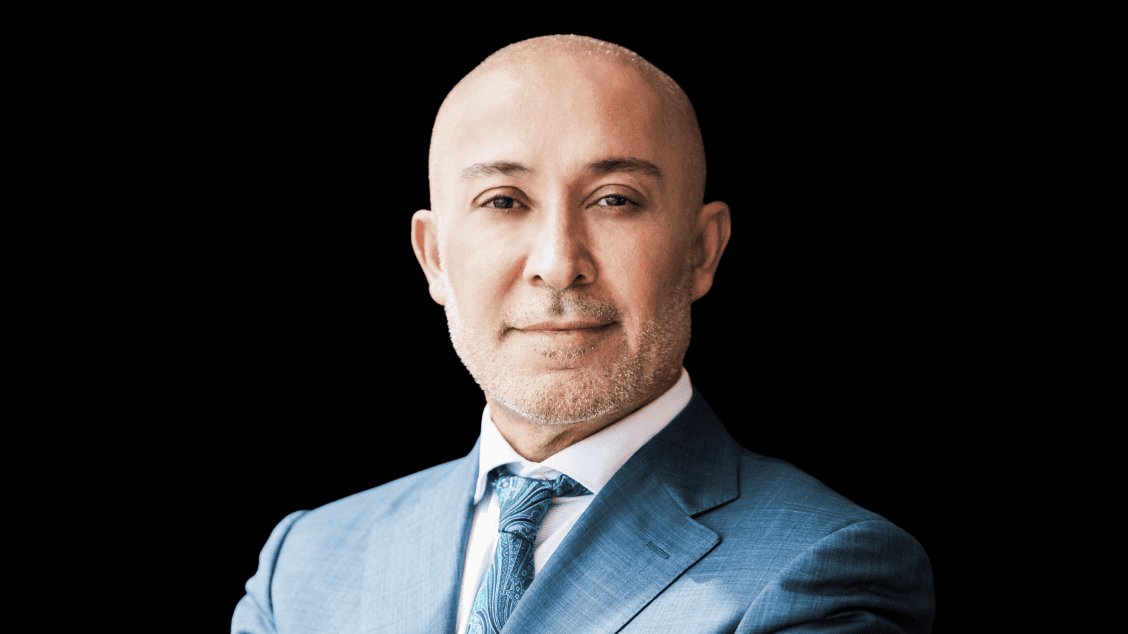


Few executives have shaped Iraq’s digital transformation as directly as Kawa Junad, founder of First Iraqi Bank.
An award-winning corporate chair, innovator, and philanthropist, Junad rebuilt Iraq’s telecom networks after the 2003 war, launched the country’s first advanced 4G network with Fastlink, and later founded First Iraqi Bank (FIB), Iraq’s first fully digital bank. From connectivity to cross-border finance, his work has helped pull Iraq from cash and cables into the digital age. In this Q&A, Junad explains what it takes to build a digital bank in a high-risk market—and why the opportunity is just beginning.
Global Finance: Tell us about your journey, when did First Iraqi bank start and what is your goal?
Kawa Junad: I’ve spent two decades building digital infrastructure in Iraq, from launching the country’s first 4G network to creating national fiber routes. That experience showed me how transformative technology can be when you remove barriers. We launched FastPay in 2016 as Iraq’s first mobile wallet, and the response proved Iraqis were ready for modern financial services. But to truly move the country forward, we needed a full digital bank, something that could issue IBANs, support cross-border payments, and give people and businesses real financial access. First Iraqi Bank went live in 2021 as Iraq’s first fully digital bank. Our goal is simple: help shift Iraq from a cash-based society to a digital, inclusive economy where anyone can open a bank account in minutes and participate in the financial system.
GF: How has the regulatory landscape for digital banking evolved in Iraq?
Junad: The evolution has been very significant in just a few years. When we started designing FIB, there was no dedicated digital-bank regulation in Iraq. We worked closely with the Central Bank of Iraq (CBI) under the existing banking law and electronic-payment regulations, often operating ahead of the regulatory curve. In recent years, the CBI introduced clear guidelines for digital banks covering capital requirements, cybersecurity, foreign ownership, and governance. There is now a much stronger focus on AML/CFT, sanctions screening, and risk management. The rules are stricter, but they create clarity and trust, which is essential for digital banking in Iraq.
GF: What potential do you see for digital banking in Iraq?
Junad: Iraq has one of the youngest populations in the region, high smartphone penetration, and very low banking penetration. That’s the perfect environment for digital banking to make a real impact. We already see this potential reflected in our customer base, with around 1.2 million individual and corporate customers, the majority of whom are young and naturally comfortable with digital technology. The opportunities are enormous for millions of unbanked people who can open accounts digitally for the first time, for SMEs who can gain access to modern payments and financial tools, for government services and salary payments to be fully digitized and just generally for everyday payments to become faster, safer, and more transparent. We’re still at the beginning of that journey, but the demand is there and growing fast.
GF: What are the main challenges when opening a digital bank in Iraq?
Junad: I can see four main challenges. The first one is regulation because we face high capital requirements, strict licensing criteria, and an intense focus on compliance. The second one is technology because you’re building a bank and a tech company at the same time, with strong cybersecurity and 24/7 availability. Then there is the issue of consumer trust: Iraq is still cash-heavy, so convincing users to trust a digital-only bank takes education and time. And finally, the risk environment.
We’re in a difficult geopolitical region, and so the anti-money laundering and financial-crime risk is higher than in many markets, so our systems are and must be exceptionally robust. We’re also in a quickly growing market and thus a quickly changing regulatory environment; which is something that absolutely forces us to remain agile. And finally, we’re in a large regional economy that is year by year becoming more integrated with the international financial system; which pushes us to up our game to be able to compete and operate in these international markets. Despite and probably because of all that, we believe the opportunity outweighs the complexity.
GF: First Iraqi Bank was recently mentioned in a financing scheme involving prepaid cards used to funnel illicit funds to sanctioned groups, what happened? What were the lessons learned?
Junad: There were instances in the wider market where certain products were misused, and this created confusion. But I want to be absolutely clear: First Iraqi Bank has never issued prepaid cards, so any suggestion that FIB was involved in such activity is simply incorrect. All cards issued by FIB are debit cards, linked to fully verified, KYC-compliant customers in line with international best-practice. From the start, we built our systems to meet a higher standard of transparency, controls, and monitoring. We continuously strengthen our KYC, AML, and transaction-monitoring processes, and I’m proud that FIB consistently sets the benchmark for responsible and compliant digital banking in Iraq.
GF: How do you ensure AMLTF compliance?
Junad: We built FIB’s compliance framework to meet international standards from day one. Our approach is based on four pillars:
- Strong governance: Independent compliance leadership, board-level oversight, and a full three-lines-of-defense model.
- Rigorous digital KYC: Biometric ID verification, sanctions and PEP screening, and enhanced due diligence for higher-risk users.
- Advanced monitoring: Real-time transaction monitoring, sanctions screening on all payments, and timely reporting to regulators.
- Culture and training: Regular AML/TF training for all staff and independent internal and external audits.
In a high-risk environment, compliance isn’t an obligation, it’s the foundation that keeps digital banking viable and trusted.