

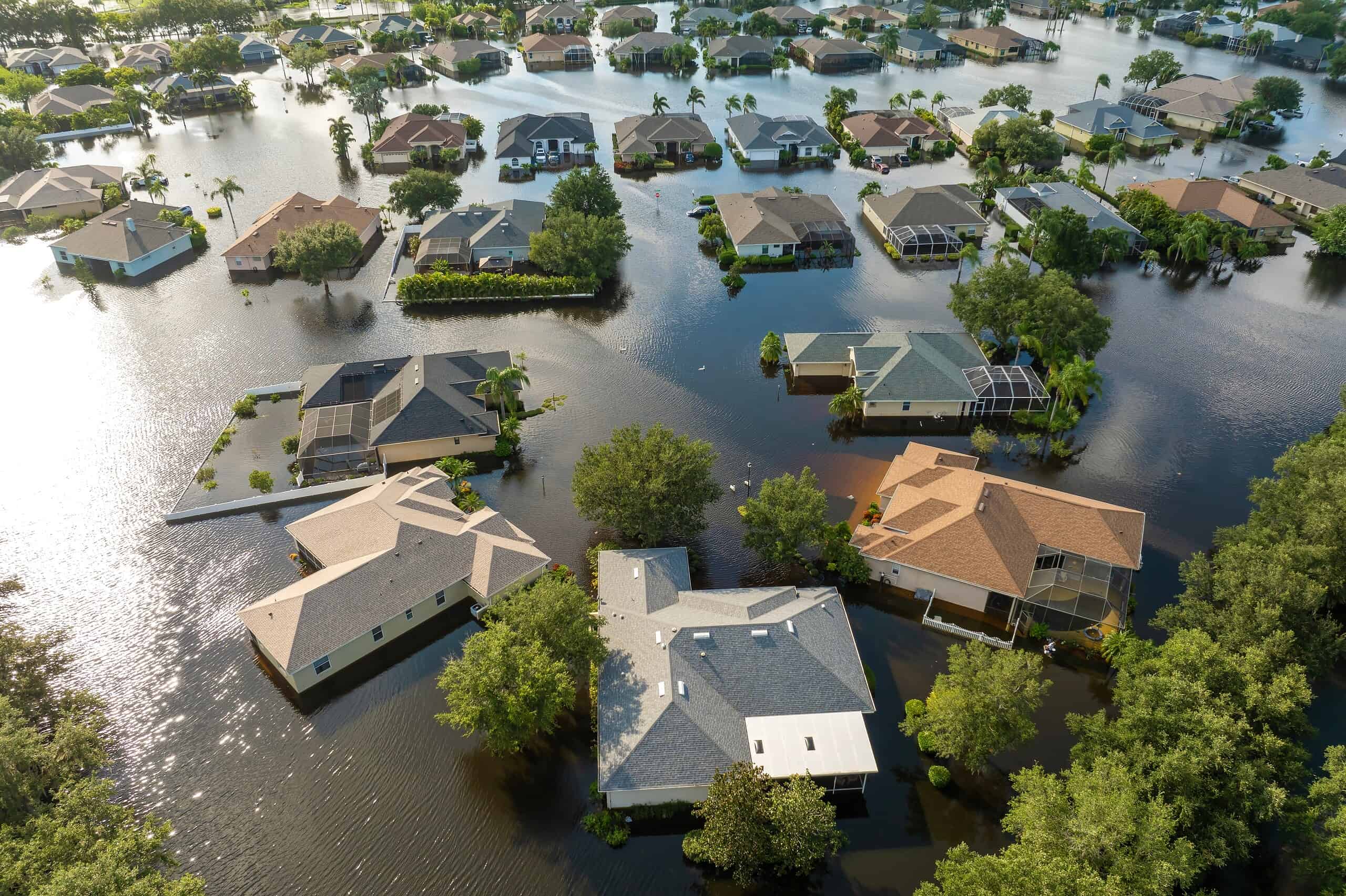


As climate change threatens insurability, adaptation finance has become a mechanism for capturing value.
When Neptune Insurance, the largest private flood insurance provider in the US, went public last October, it quickly achieved a multibillion-dollar valuation. For investors, it signaled that climate adaptation can be both profitable and scalable and that markets are becoming willing to reward business models built around adaptation rather than avoidance.
Built on AI-powered underwriting that integrates satellite imagery and forward-looking climate data, Neptune operates on the assumption that accurately pricing climate risk can restore insurability rather than signaling a retreat from it. During Hurricane Helene, the St. Petersburg, Florida-based company posted an 18% loss ratio—dramatically outperforming the federal government’s National Flood Insurance Program—while offering premiums 30% to 40% lower than alternatives.
“What we’re seeing in real time is that properties once considered uninsurable become insurable again when they’re rebuilt to modern codes and elevated,” says CEO Trevor Burgess. “That’s climate adaptation in practice.”
The potential is significant. The global investment opportunity for climate adaptation solutions is projected to grow from $2 trillion today to $9 trillion by 2050, according to a report from GIC, the Singapore sovereign wealth fund. The 2025 report, conducted with consultancy Bain, forecasts annual revenues from climate adaptation solutions—including weather intelligence systems, wind-resistant building components, flood protection infrastructure, and water conservation technologies—growing from approximately $1 trillion today to $4 trillion by 2050.
P&C Innovation
That potential is one reason the insurance industry is exploring new ways to help clients manage their risk.
“The change in insurers’ mindset to adopt innovative and transformative solutions is much higher than I have ever seen, especially in P&C insurance, where carriers are leading with AI-led solutions to study and manage climate risk,” observes Adil Ilyas, who heads the insurance group at Genpact, a professional services and technology consultancy specializing in digital transformation and AI. He points to AXA, Zurich, Allianz, and others that have launched parametric insurance solutions that give organizations fast-acting liquidity and cash flow following a disruptive event.
The acceleration of climate change adds urgency to opportunity. On LinkedIn, Allianz board member Günther Thallinger wrote in March 2025 that climate change is on the way to transforming life as we know it: “We are fast approaching temperature levels—1.5°C, 2°C, 3°C—where insurers will no longer be able to offer coverage for many of these risks. The math breaks down; the premiums required exceed what people or companies can pay. This is already happening. Entire regions are becoming uninsurable.”
A 2025 Allianz report, “Climate Risk and Corporate Valuations,” looks at industries facing accelerating risk, disrupted coverage, and fundamental questions about the future insurability of assets.
“We’re seeing a massive repricing event that’s going to unfold over the next couple of decades,” says Lead Investment Strategist and co-author Jordi Basco Carrera. “The question is whether it happens in an orderly way or whether we see a disorderly transition that creates much more volatility and destruction of value.”
The report examined how different climate scenarios would affect corporate valuations across 10 sectors in the US and Europe, using discounted cash flow models and interest coverage ratios.
Under the Net Zero 2050 scenario, representing aggressive climate policy with ambitious carbon-reduction targets, European real estate faces a staggering 40% correction in valuations. Telecommunications and consumer staples also see major setbacks. In the US, the healthcare and consumer discretionary sectors would each drop by roughly 16% while energy and basic resources face smaller declines of 6% to 7%, reflecting partial adaptation through renewables and critical materials demand.
The alternative—a delayed transition scenario where policy intervention is postponed—creates even more dangerous dynamics.
“A delayed transition is not a soft landing,” Basco Carrera observes. “It’s storing up energy for a much more violent adjustment later. The sectors that look like they’re benefiting in the short term are accumulating hidden risks.”
For CFOs managing enterprise risk, either scenario creates a new urgency. Traditional insurance would not be able to adequately protect against the systematic repricing of asset values driven by climate transition policies. Coverage typically compensates for discrete physical losses—a flooded warehouse, a storm-damaged facility—but offers no protection against the gradual or sudden devaluation of entire portfolios as carbon-intensive business models become economically unviable.
From Valuation Risk To Investment Opportunity
This is where adaptation finance enters as not just risk management, but a mechanism for capturing value during the transition.
Sectors that invest early in climate adaptation show remarkable resilience across all scenarios, according to Allianz’s research. Technology and healthcare demonstrate strength under every climate pathway analyzed while energy sectors that diversify into renewables and utilities and upgrade infrastructure face smaller corrections than those maintaining status quo operations.
Allianz’s research methodology was innovative, Basco Carrera notes, using data from the Network for Greening the Financial System (NGFS), a voluntary, international group of central banks and others launched in 2017 to manage climate-related risks in the financial sector.
“We integrated three NGFS transition scenarios into traditional financial valuation methods,” he explains. “This lets us see not just which sectors face risk, but specifically how much value is at stake and over what timeframe. That granularity is what CFOs need to make capital allocation decisions.”
The analysis introduced the concept of “Climate Elasticity of Demand,” measuring how global warming affects demand for goods and services. What emerged is a sophisticated view of how climate change will reshape entire markets, not just damage individual assets. Companies producing flood-resistant construction materials, for instance, don’t simply benefit from replacing damaged components after disasters. They capture sustained market share as building codes tighten, insurance companies mandate resilience standards, and property developers recognize that climate-resilient buildings command premium valuations.

Commercial real estate provides an example of adaptation intelligence in practice.
Munich Re’s Location Risk Intelligence tool helps users determine their climate-related expected annual losses, according to Thomas Walter, Munich Re product marketing manager. A US-based real estate investment company using the tool to evaluate a multimillion-dollar building purchase found that the building sat in a highly flood-prone area, which led the company to walk away. Within months, a severe flood hit the building.
“They avoided both losses and depreciation,” Walter says.
Returns Beyond Avoided Losses
The investment case for adaptation strengthens when the full spectrum of value creation—not just avoided disaster costs—enters the picture.
The World Resources Institute, a global research nonprofit based in Washington, DC, analyzed 320 adaptation and resilience projects across agriculture, water, health, and infrastructure. Its research found that cumulatively, the analyzed investments cost over $133 billion and were expected to generate $1.4 trillion in benefits over 10 years. Individual investments generated an average return of 27%.
These figures are likely too low, says WRI senior fellow Carter Brandon: “We found that only 8% of investment appraisals estimated the full monetized values of these dividends, suggesting that the $1.4 trillion and the average rate of return are likely substantial underestimates.”
In a recent WRI report, Brandon and colleagues put forth a “Triple Dividend of Resilience” framework that addresses avoided losses from climate events, induced economic development, and additional benefits.
“By positioning portfolios to respond swiftly to emerging climate policies and market dynamics, investors not only limit potential losses but also capitalize on opportunities presented by the growing green economy,” Brandon contends.