


Strength meets structural limits going into the second half of 2026.
On the surface, Spain enters the second half of this year as one of Europe’s best-performing economies, most visible in the pace of tourist activity across its major cities. Last year, Spain welcomed 96.8 million tourists: an all-time high. In the first two months of 2026, nearly 10.7 million people visited the country, a 2% year-over-year gain.
GDP numbers confirm the impression. Following 2.8% GDP growth in 2025, the Bank of Spain recently raised its 2026 forecast to 2.3% from 2.2%. At the same time, it cautioned that energy-related shocks could prompt a departure from its base case. With or without volatility in the Middle East, the central bank sees 2027 GDP growth of 1.7%, down from its December projection of 1.9%.
By comparison, most 2026 estimates project the eurozone to grow between 1.1% and 1.3%, with larger economies such as Germany and Italy expected to lag.
Spain’s comparative strength nevertheless sits alongside growing structural imbalances, such as housing scarcity and energy advantages shaped by its evolving power mix, both of which will help determine whether growth translates into durable financial stability or begins to constrain it.
Banking: Strength or Stagnation?
A key question for investors and businesses is whether Spain’s financial system will evolve to support growth.
The collapse of Banco BBVA’s bid for Banco de Sabadell last fall removed what had been the most obvious path to scale in Spain’s banking sector. What replaces it is less clear.
On the surface, Spanish banks look exceptionally strong. Profitability remains among the highest in Europe, capital levels are solid, and banks continue to reward shareholders through dividends and buybacks. BBVA’s €3.96 billion program is just one example of a broader trend across the sector, one that also includes Banco Santander, which says it will return at least €10 billion to shareholders between 2025 and the end of this year.
Santander, however, is combining capital returns with expansion through its pending integration of Webster Bank in the U.S., the continued build-out of its digital platform Openbank—now operating across Germany, Portugal, the Netherlands, the U.S., and Mexico — and its broader One Transformation strategy aimed at building a more unified global platform.
Not every bank has a large enough capital base to pursue both a popular buyback program and a global, digital-first expansion strategy. That points up the dilemma facing the rest of Spain’s banking sector. Without further consolidation or a meaningful push into cross-border expansion, parts of the sector could remain highly efficient domestically but limited in scale relative to Europe’s largest cross-border banking groups.
“There is still room for consolidation in the system,” says Ángela Cruz, executive director, Financial Institutions Ratings at Scope Ratings, noting that strong organic growth and ownership structures may reduce incentives for further deals. “Spanish banks are not at a disadvantage in this regard.”
The issue, in other words, is not immediate weakness; it is whether today’s strength reduces the urgency to pursue scale while conditions remain favorable. Going into the second half of 2026, the issue is less about profitability — which remains strong — and more about trajectory. Are Spanish banks optimizing what they already have, or positioning themselves for what comes next?
Housing Constraints
That question is already beginning to play out in the housing market. Unlike the 2008 global credit collapse, today’s risk isn’t bank insolvency, but a structural imbalance between supply and demand and how that imbalance is reshaping the mortgage market.

Spain is not facing a demand problem. “Looking ahead to H2, we expect mortgage growth to remain more constrained by lack of supply than by demand or credit conditions,” says Pedro Álvarez Ondina, economist at CaixaBank Research.
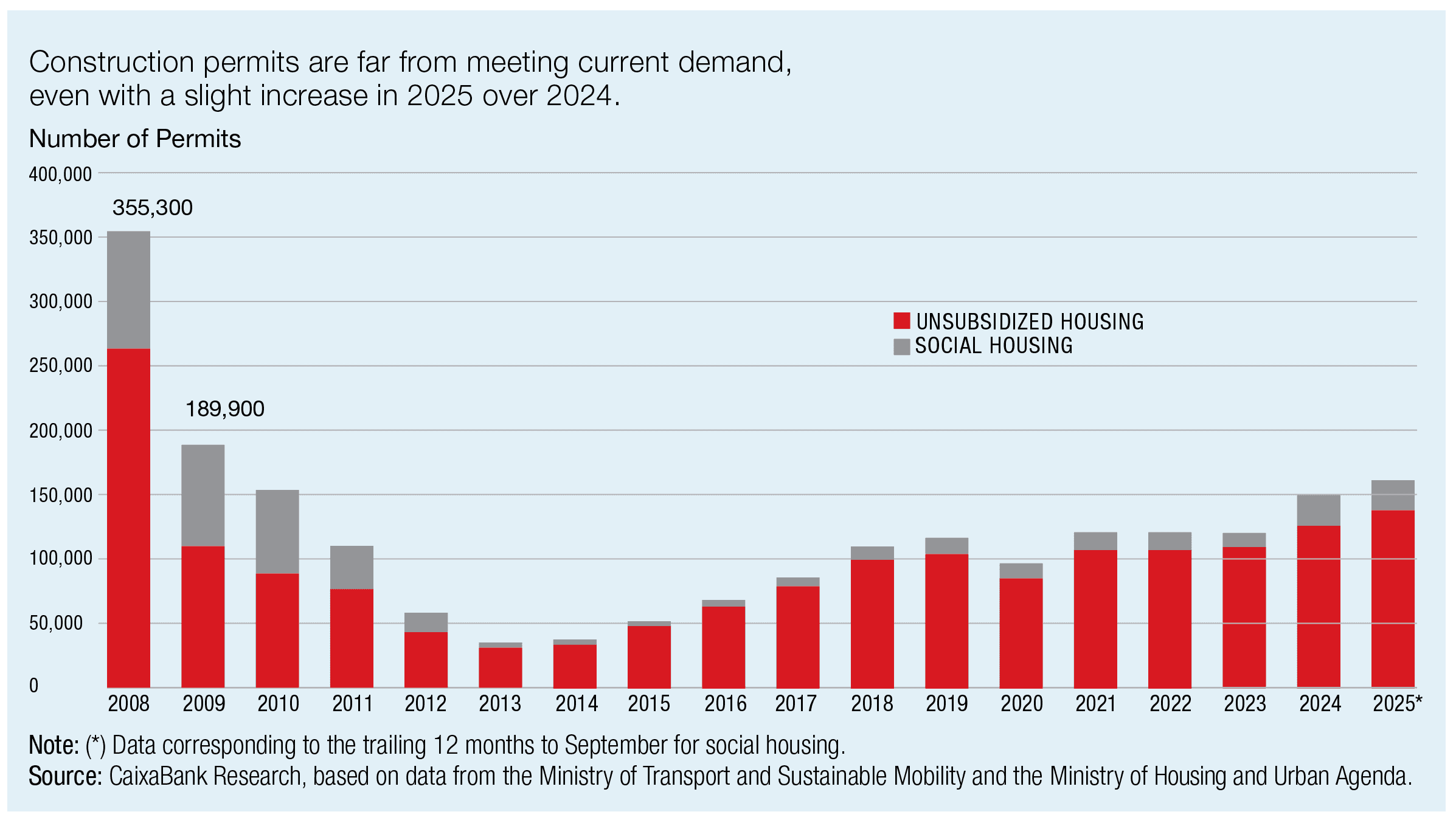
Despite a supply deficit that has grown to over 730,000 homes since 2021, new building permits are down roughly 54% from 355,300 in 2008 to just 162,195 last year, according to CaixaBank Research. The imbalance continues to support prices, particularly in sought-after locations such as Madrid, Barcelona, Valencia, Alicante, and Málaga. From a banking perspective, it also reinforces asset quality by limiting the risk of a sharp correction.
“Constrained supply helps limit downside risks to prices,” Álvarez Ondina observes, “but it is increasingly acting as a drag on mortgage volume growth.”
Scope’s view aligns broadly with that analysis, but flags some additional pressure points. “House-price growth is outpacing real disposable income,” Cruz says. “Debt-affordability metrics have deteriorated and the proportion of new, high-LTV [loan-to-value] mortgage lending has increased. But neither points to imminent asset-quality pressures.”
The composition of demand is also changing.
“The decline in the share of home purchases without a mortgage — from around 35% to 30% — should not be interpreted primarily as a cooling-off of foreign or cash-rich buyers,” says Álvarez Ondina. “Instead, it reflects a normalization of financing conditions after the sharp tightening of 2022–23.” As borrowing costs have stabilized, leverage has become attractive again, even for buyers with the wherewithal to pay in cash.
For banks, this yields a more nuanced second-half outlook.
Rising collateral values and a structurally undersupplied market continue to underpin credit quality. The pace of new lending is increasingly tied to the availability of housing stock rather than underlying demand.
The takeaway is that the Spanish housing market shows no signs of weakening. Rather, it’s supply-constrained in a way that increasingly defines both price dynamics and the trajectory of credit growth.
Energy as Advantage
If housing represents one potential financial constraint on Spain’s growth, the energy sector illustrates one of its clearest structural advantages.
The energy shock triggered by volatility in the Middle East has found Spain less exposed to gas-driven electricity pricing than many of its European peers. Thanks to its ongoing transition to renewables such as wind and solar, gas only influenced the country’s price of electricity for 15% of hours this year through early March, compared to 89% in Italy and 40% in Germany, according to Ember, a London-based global energy think-tank.
Spanish manufacturing has exhibited notable resilience in this environment.
“Firms are now structurally better prepared,” Álvarez Ondina says, citing lower energy intensity, greater use of long-term contracts, and increased investment in self-generation and efficiency. Going forward, he anticipates these factors “should help cushion, though not fully offset, renewed energy price shocks.”
But the system faces its own constraints. As renewables penetration increases, pricing dynamics are becoming more complex, with periods of excess generation pushing wholesale prices lower during peak production hours. This phenomenon, known as price cannibalization, sits alongside grid bottlenecks as a factor that investors will be watching closely to assess how much more capacity the market can absorb before long-term yields come under pressure.
That said, the combination of a healthy tourist economy, a growing population, a resilient housing market, and an energy advantage continues to make Spain an outlier in a relatively underperforming European economy. Its next phase of growth will depend on the system’s ability to support and nurture them.
This article appears in the June 2026 issue of Global Finance Magazine.