

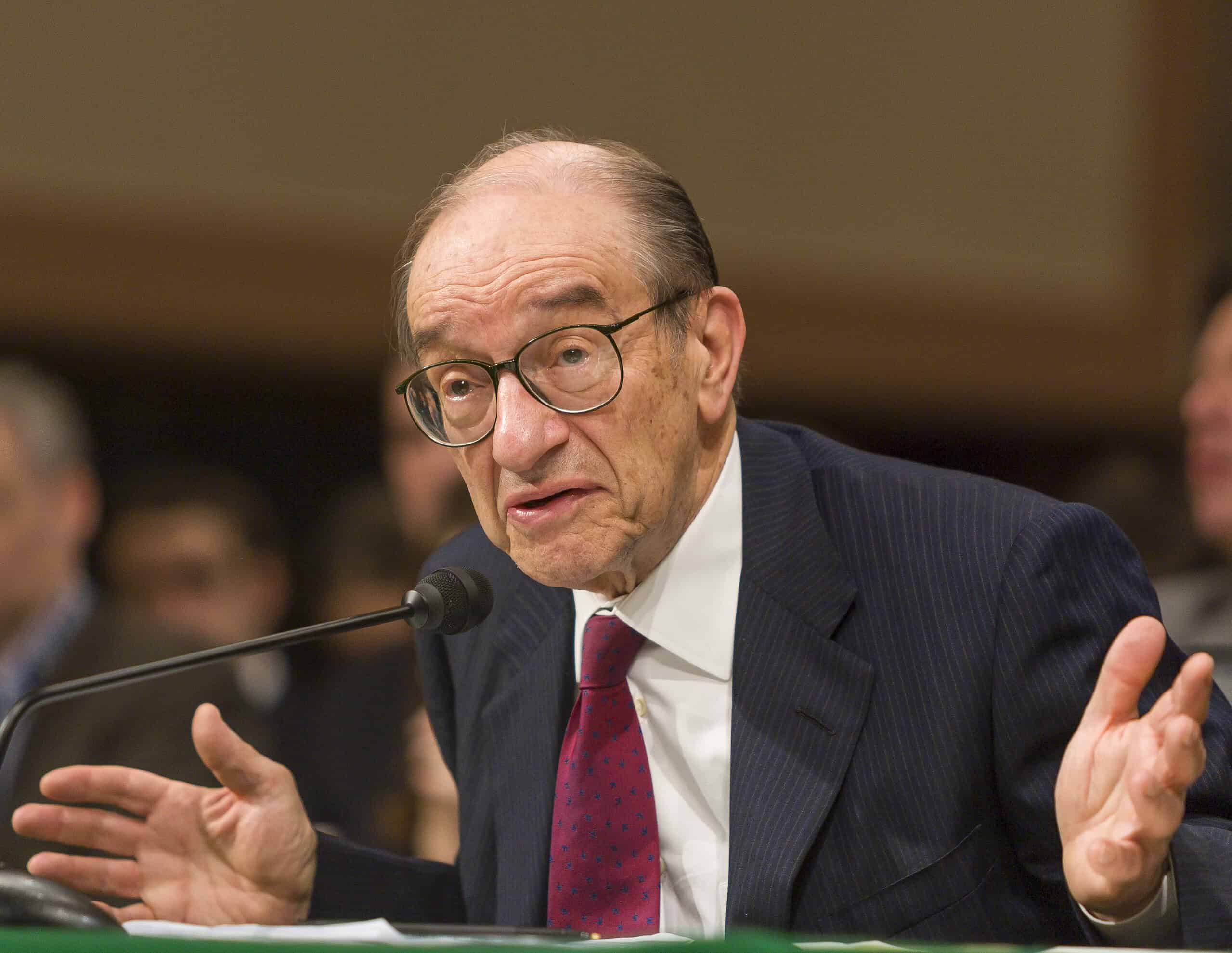


As the financial world remembers the former Fed chair, economists weigh his massive macroeconomic legacy.
Alan Greenspan, the second-longest serving chairman of the Federal Reserve’s Board of Governors, has died just months after his 100th birthday.
Known as “The Maestro,” Greenspan helmed the Fed under five U.S. presidents, from August 1987 until January 2006. He managed the central bank through two market crashes, two recessions, and various financial crises. Through it all, the U.S. economy experienced significant macroeconomic expansion, rising asset prices, and a dramatic shift in corporate finance.
The Greenspan Put
Early in his tenure, Greenspan intervened to mitigate the impact of the 1987 stock market crash, a move known as the “Greenspan put.” The monetary policy lowered interest rates and injected liquidity, stabilizing the economy, restoring investor confidence, and mitigating financial shocks. However, Fed intervention also incentivized investors to take excessive risks, fueled speculative bubbles such as the 1990s dot-com bubble, and led to market expectations of future interventions.
The Greenspan put is a bit of an illusion, Kenneth Rogoff, professor of Economics at Harvard University and former chief economist at the International Monetary Fund, wrote in an email exchange.
“When markets collapse, the interest rate required to maintain stable inflation will typically also temporarily collapse,” Rogoff wrote. “His biggest mistakes were in regulatory policy, where he had too much faith in financial market innovation and too hands-off an attitude towards regulation. We are now, in the second year of the [second] Trump administration, repeating that mistake.”
A Man Remembered
“He was a great central banker who helped lead his country through two decades of prosperity,” said Ben Bernanke, a Distinguished Fellow in Residence at Brookings Institution and Greenspan’s successor at the Fed, in a statement. “I always found him generous with his time and insights. We are still learning from him, even if he is no longer with us.”
Don Kohn, a senior fellow at Brookings and former Fed governor and vice chair, remembered Greenspan encouraging Fed staff and fellow policy makers to voice new ideas and analytical insights while asking them to find the weak points in the hypotheses he put forward.
“But those ideas, insights, and challenges need to be backed by evidence and solid reasoning,” he wrote in a post on Brookings’ website. “Once when he asked me what I thought we should be doing on policy, I started my response with, ‘My gut tells me…’ He quickly cut me off: ‘That’s not your gut, Don, that’s your experience and knowledge.’”
Greenspan’s willingness to experiment to lower the unemployment rate, which peaked at 7.4% in 1992, drew many admirers.
“He pushed it lower than the conventional wisdom had ever thought possible, and discovered that it was possible to have more Americans in work without sparking inflation,” Justin Wolfers, professor of Economics and Public Policy at the University of Michigan, wrote in an email exchange. “Hundreds of thousands more people found work, and their families could afford a better life because he showed that there’s nothing natural about what many economists had called the natural rate of unemployment.”
Although Wolfers did not agree with all of Greenspan’s decisions, he noted that “his intellectual courage and devotion to the public good were never in doubt. He lived a big life and made a difference.”
Contact the author at rdaly@gfmag.com