



China and South Korea are driving the surge, but regional growth is slowing.
This article appears in the September 2026 issue of Global Finance Magazine.
Global goods trade surged to US$13.7 trillion in the first half of this year, up 12.5% year over year, with Asia-Pacific leading the charge. The figures reflect an ongoing reconfiguration of global trade balances, as China’s goods trade surplus expanded further in the first quarter and the U.S. goods trade deficit continued to narrow.
But the trade figures only tell half the story, as growth is slowing across the Asia-Pacific region.
According to UNCTAD’s Global Trade Update, East Asia recorded the strongest trade growth in the first quarter. Both developed and developing economies in the region expanded at rates well above the global average, but developing economies drove most of the growth. While trade by developing economies globally, as well as South-South trade, recorded double-digit gains over the 12 months to the first quarter of 2026 when East Asia is included, they registered an overall contraction when East Asia is excluded, driven largely by reduced imports and exports from the Middle East and South Asia.
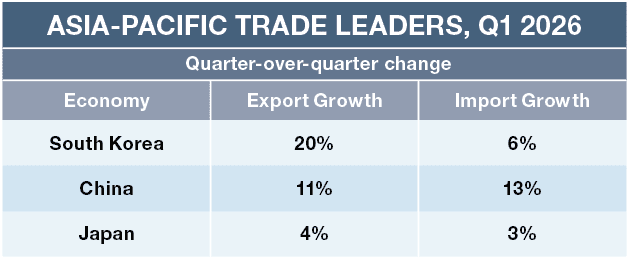
South Korea recorded the region’s strongest export growth, up 20% quarter over quarter, followed by China at 11% and Japan at 4%. South Korea also posted the strongest growth in services exports, at 9%. China led in imports at 13%, with South Korea next at 6% and Japan at 3%.
Asia-Pacific’s strength in automotive manufacturing and AI innovation is fueling trade growth in both industries. According to Allianz Trade, global exports of AI-enabling goods surged 280% between 2014 and 2025 to $3.8 trillion.
“Asia dominates the supply side, accounting for 65% of global AI-related exports and seven of the top 10 exporters, led by China (18% of AI-related exports), Taiwan (12%), and Hong Kong (11%),” the report states.
New Alliances
Major geoeconomic shifts continue to reshape trade patterns.
Canada’s trade dependence on China is rising—up 0.9% from the fourth quarter of 2025 to the first quarter of this year—while the trade relationship between the U.S. and China is weakening. But East Asian economies, including Thailand and Vietnam, are becoming more dependent on both China and the U.S.
Much of the reported trade growth reflects higher prices rather than higher volumes, UNCTAD noted, as escalating costs in energy, transport, logistics, and manufacturing fuel trade inflation. And trade strength does not equal broad-based economic strength; UNCTAD’s own forecasts point to a slowdown ahead in GDP.
The organization’s Trade and Development Foresights 2026 report projects that economic growth in East Asia will slow to 3.7% for the remainder of the year, largely due to the region’s heavy reliance on energy imports from the Middle East. China’s growth is expected to ease to 4.6%, within its newly adjusted target range of 4.5% to 5%. Economic activity in Southeast Asia is expected to hold broadly steady at 4.3%. While South Asia remains the fastest-growing subregion, GDP growth there is forecast to slow from 6.3% in 2025 to 5.5%, with rising fossil fuel prices threatening to stoke inflation and financing pressures.
Deborah Ritchie is a contributing writer based in the U.K.