


Look past the puppies, gelato, and robots and you'll see the true future of AI and banking.
I’d like to say I spent Monday lounging in the heat and humidity on Miami’s South Beach while everyone back home in New York was recovering from a nor’easter. Instead, I settled in for a different kind of experience: Sibos 2026 at the Miami Beach Convention Center, a massive, modern—and aggressively air-conditioned—complex. You wouldn’t know it was 91 degrees outside until you stepped back out the glass doors.
The place is enormous. As I walked what felt like half a mile from the main exhibition hall to the press room, a weary attendee passed me and said, “They thought of everything—except scooters to get around.” It was only 10 a.m., and I had barely seen 10% of the venue.
What stood out first were the booths. Forget canvas backdrops, PVC railings, and a few folding chairs. These were structures, complete with leather couches, lounges, media studios, espresso machines, food buffets, neon lights, wall-sized video displays, and video-game-style challenges designed to lure visitors and outdo the neighbors. Swift, the cross-border payment giant that hosts the event, had the largest and most elaborate space by far. The exhibition hall felt less like a trade show than a temporary financial metropolis, one in which I got lost several times despite carrying an interactive map.
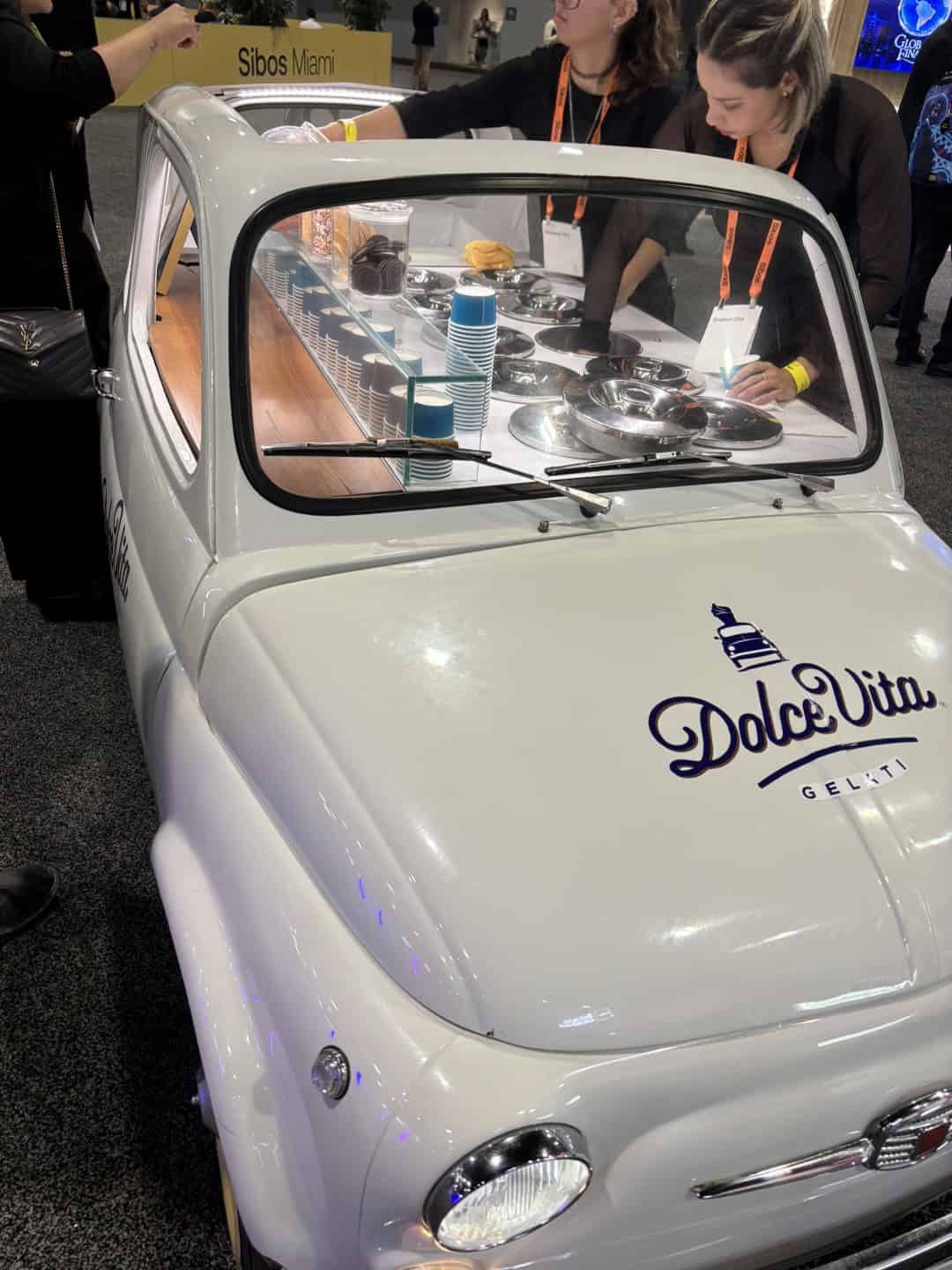
Sprinkled through that vastness were welcome human touches: a vintage Fiat converted into a gelato stand, a mobile home trailer serving coffee and doughnuts, and a Puppy Lounge where a half-dozen or so pups received an impressive amount of attention from the world’s bankers.
Encounter With a Nontalking Head
I had several interviews lined up and sat in on a handful of panels, but the most telling conversation may have been the one I didn’t have.
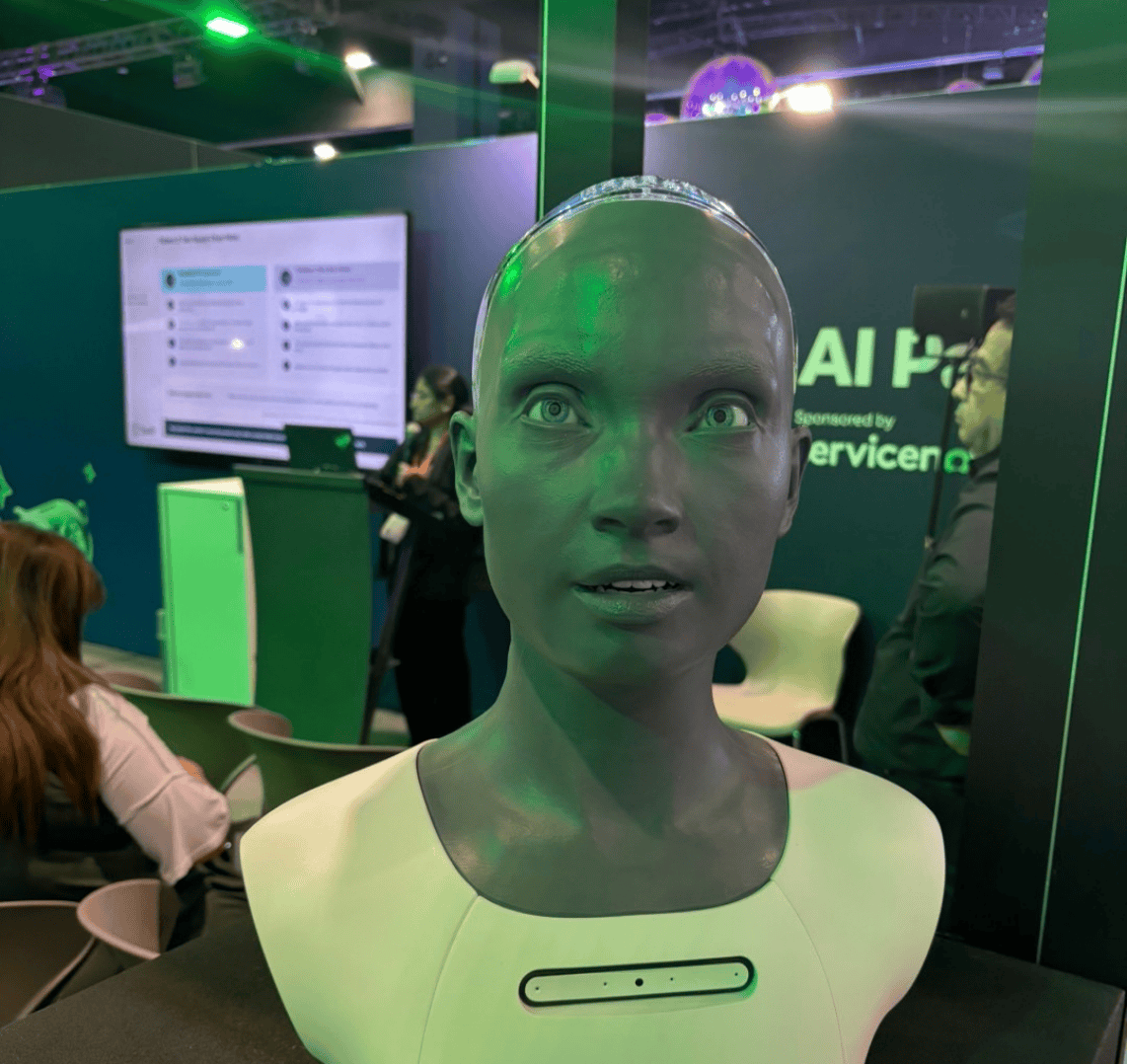
My Global Finance colleague Denise Bedell introduced me to Ami. Denise said that Ami had been chatting with conferencegoers and delighting them with her banter—which became even more remarkable when I saw that Ami is an artificial-intelligence-powered robotic head mounted on a pedestal.
When I approached, however, Ami was not allowed to talk to me because a presentation was in progress at her booth. As I got closer, her piercing blue eyes locked with mine. Her expression seemed to invite conversation, but no words were exchanged. It was a little disconcerting, but Rory Thompson of Engineered Arts assured me I could speak with Ami after the presentation ended.
The silent robotic head proved to be an apt symbol for the day.
AI was everywhere at Sibos, but the most compelling discussions were not about making it perform on command, like a sideshow attraction. They focused on putting it to work inside banks—forecasting cash, answering service questions, checking trade documents, and flagging suspicious transactions—while building trust and preserving a human element.
Jane Fraser, CEO of Citi, made much the same point during the opening plenary.
“There are a lot of shiny objects being built in this space at the moment, and a lot of hammers in search of a nail,” she said on the main stage. “Our industry’s responsibility is to understand what it is our clients need.”
Indeed, my scheduled interviews for the day gave me a clear view of where and how AI is being used.
First, I met with Tom Durkin, global head of CashPro, and Duncan Lodge, global head of Supply Chain Finance, at the Bank of America booth.
Durkin provided the clearest through-line of the day: Generative AI may make the subject feel new, but he described the bank’s experience as a progression spanning roughly a decade, beginning with its automated assistant, “Erica,” on the consumer side and moving into more specialized corporate-banking uses with CashPro.
His point was not that one breakthrough product had changed everything; it was that the bank had built a record of applying AI to specific client problems and could reuse the technology and lessons across its various lines of business.
He gave several examples that coincided with an announcement of a Bradesco pilot using the bank’s cross-border real-time-payments platform (a development we covered separately). But the announcement matters mainly as an example of change arriving through a familiar infrastructure rather than wholesale replacement.
Durkin explained how various CashPro products use AI to give corporate clients better insight into cash positions and bond orders. CashPro Chat applies generative AI to client servicing, and about half of all questions can be handled by AI instead of being passed along for manual resolution.
‘Beyond the PDF’
The harder questions begin when AI reaches areas that are less tidy, and the cost of a wrong answer is higher. In trade finance, Merlin Dowse, director of product management at CGI, described interoperability as more than a technical challenge to digitizing trade finance. Legal frameworks, data standards and confidence in the source all determine whether digitized trade can scale.
The industry has become adept at extracting information from physical documents and moving it through digital workflows, he said. The next step, he said, is to go “beyond the PDF,” beyond merely digitizing paper and toward data that participants can trust at its source. AI can help banks cope with labor-intensive document examination and transactional due diligence, but it cannot simply be dropped into a regulated process and trusted blindly. Auditors may ask how a decision was reached, and trade rules often require interpretation rather than a clean yes or no answer.
“You have to keep the human in the loop,” Dowse explained.
The ‘Glass Box’ Approach
The stakes in financial crime are rising sharply. ThetaRay CEO Brad Levy and Garima Chaudhary, VP of Financial Crime and Compliance AI, typically operate in the specialized world of anti-money-laundering conferences. Their presence at Sibos reflected a convergence of payments, banking infrastructure, and compliance. As a company that offers solutions for anti-money laundering and online fraud, Chaudhary argued that compliance should not be viewed merely as a hurdle. A bank that cannot control financial crime as transactions accelerate cannot safely expand into new markets.
“Regulators want to make sure you have a system that actually catches bad guys,” Chaudhary said.
Bad actors have access to the same technological advances as institutions, forcing banks to defend against threats such as generative AI, deepfakes, and synthetic identities. Navigating those risks means moving away from opaque technology. Levy offered an interesting alternative to the notorious AI “black box.” He called it a “glass box,” in which a model’s results are “predictable, explainable, and fully auditable.”
“Think of it like a car carburetor 30 years ago,” he explained. “You cared about the spark plugs and whether it was flooded. Today, you don’t think about it because it moved under the hood. Eventually, AI will move under the hood, too. But first, institutions need comfort through governance and transparency.”
Andy Schmidt, vice president and global industry lead for banking at CGI, framed the balance as a concern in both directions.
“Overreliance on AI will lead to complacency and will erode critical thinking,” he said, because it encourages people to accept an answer without understanding its context. Meanwhile, underusing AI causes organizations to miss out on broader efficiencies.
“What I’m seeing a lot of banks do is just sprinkle a little AI” on top of a process, he added, rather than reengineering it to take full advantage of the benefits that AI can provide.
By the end of Day One, Ami’s silence felt less like a glitch and more like a feature. The loudest AI displays on the exhibition floor were designed to draw a crowd. Meanwhile, the most credible applications are already baked into the DNA of banking, where no one can see them.
Read more news related to Sibos 2026 in Miami.
Paul Curcio is the editor of Global Finance Magazine. Contact him at paul.curcio@gfmag.com.