


With global trade fracturing amid tariffs and risk, corporations are rethinking supply-chain costs.
This article appears in the November issue of Global Finance Magazine.
When a Citi analyst pressed SIG Group CFO Ann-Kristin Erkens on the company’s first-half call in July about whether its €80 million inventory build would become permanent, he was asking a version of a question finance chiefs now routinely face: How much should a company pay to protect itself from supply shocks?
Part of the inventory increase came from valuing stock at higher input costs and part of it was deliberate, said Erkens, who has since been promoted to CEO. “There is an element of safety stock in there,” she said; whether the Swiss packaging maker works it down by year-end will depend on market volatility.
Companies that once scoured the globe for the lowest-cost production to feed just-in-time inventories now must account for geopolitical risk, surprise supply disruptions, and the price of keeping operations running when global trade falters.
The new era of de-globalization is complicated by the need to spread costs out. Some are on the balance sheet as extra inventory. Others may be in capex as relocated or duplicate capacity. Sometimes costs appear as financing for a company signing up new suppliers. A CFO who wants to nail resilience must add up these scattered costs and figure out how much the business can recover.
Shock Absorbers
Inventory can be the quickest lever to pull, and usually the first.
At Authority Brands, a consumer services company, some of the larger franchisees and company-run locations bought extra HVAC compressors and outdoor units in the first quarter of 2025, ahead of tariff-driven price increases, said CFO Josh Greear.
In a normal year, those operators carry “weeks of inventory, not months.” Authority Brands negotiated with distributors on behalf of the whole system to lock in stock at existing prices. The manufacturers ended up raising prices anyway, including those building in the U.S., because every competitor’s costs had gone up.
Trane Technologies experienced the same whiplash on a large balance sheet. During the company’s second-quarter 2026 earnings call, CEO Dave Regnery said it had added four times the capacity to its applied HVAC business over the past three to four years, and guided 2026 capex to 2% to 3% of revenue. Part of that build-out runs through the P&L as production ramps up, CFO Chris Kuehn added, and may weigh on operating leverage in the very near term.
Trane is “not going to get behind” and is “not turning away any orders,” Kuehn said.
Francois Motte, CFO of rare-earths developer Aclara Resources Inc., has worked through how to split the cost of resilience with customers and governments.
Operating costs at Aclara, which has operations in Brazil, Chile, and the U.S., are close to Chinese companies’, he said. Its disadvantage is the cost of capital. Governments in the U.S., Japan, South Korea, and Brazil are narrowing that gap with long-dated finance, often 10 to 12 years out and in some cases up to 20. Their backing also tells customers a supplier has survived due diligence, said Motte, which can matter to buyers as much as the money.
Aclara pairs take-or-pay offtake agreements with a minimum price that lasts until its construction debt is repaid, he explained. In return, it offers customers a price cap, protecting them when supply is tight. After the payback period, Aclara is willing to move to index pricing.
Gas turbine makers sitting on years of backlog are paying up for yttrium, a rare earth that makes up about 8% of the mix in thermal barrier coatings, and yttrium now accounts for roughly 30% of the value of Aclara’s output, Motte said. Carmakers competing with Chinese electric vehicles have far less room to pay.
The Cost of Weak Suppliers
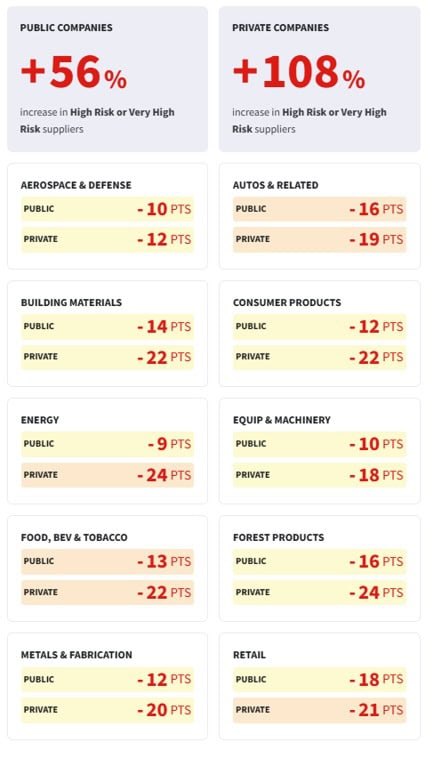
Costs that customers refuse to absorb land on suppliers. Rapid Ratings International Inc., a supply chain risk intelligence firm, modeled country-specific tariff rates, assuming suppliers could pass through only about half the added cost. Even in that scenario, the number of public-company suppliers rated High or Very High Risk for weak financial health rose 56%. Among privately held suppliers, the number struggling dangerously more than doubled. (The chart on the left shows changes in financial health scores across sectors.)
RapidRatings CEO Charlie Minutella described how painful this can be in practice.
A manufacturer learns that the supplier of a critical engineered component is heading into financial restructuring. Qualifying a replacement, with new tooling and a production ramp, would take several quarters, and by the time the distress is visible, that window has closed. The manufacturer instead pays a sum in the mid-tens of millions of dollars to keep the supplier operating.
“Wait for headlines or disruptions to emerge, and the only option left is writing the check,” Minutella said.
Late discoveries reach the plant floor, too, observed Catherine Cormier, chief innovation officer at Assent Inc., a supply chain software firm. Manufacturers must retool entire factories and halt production to change a product’s composition for regulators—and some must destroy finished goods they can no longer sell.
Supply chain consultancy Miebach Consulting GmbH, reviewed the sprawling production footprint of a consumer goods manufacturer, including its actual and projected P&L for the previous few years. In each year, an outside event knocked results off plan.
“Find me a year we’ve had a white swan,” quipped Nick Banich, chief revenue officer for Miebach in the U.S. and Canada.

Miebach
Some shocks had hit more than once, Miebach’s review revealed, so the manufacturer built them into its long-term plan. That made shifting some production from Southeast Asia to Mexico look more attractive. Labor costs would rise 15% to 20% while unit costs would increase 7% to 14%, depending on the product. But cutting about 20 days of ocean transit would free up working capital, and the move would reduce the company’s exposure to another round of tariffs.
Raising inventory on everything can be an easy response, and the most expensive one. After Covid-19, many organizations “beefed up inventory, and it didn’t really solve a lot of the service issues,” Banich said. He argues for segmenting by SKU and by supplier. “It’s not going to make sense to have committed capacity with an additional supplier with machines running at 40% utilization for everything.”
Life sciences companies already hold what they call strategic stock against low-probability, high-damage events, and he said he expects other industries to borrow the approach.
Weld Royal is a contributing writer based in the U.S.