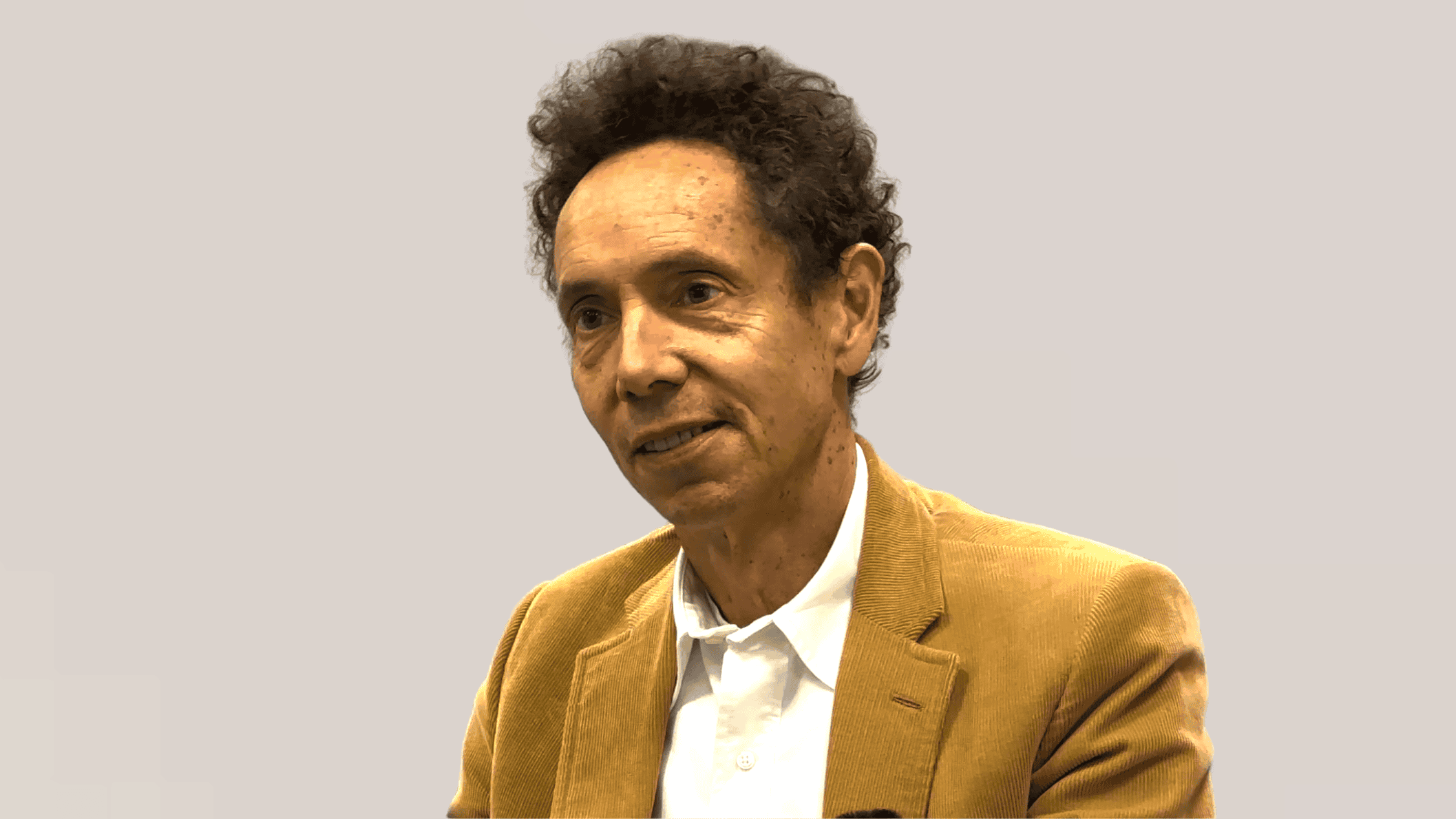


Gladwell talks to Global Finance about AI's potential, Elon Musk, teacher bots and his worries for 2027.
At this year’s World Business Forum at New York’s Jacob Javits Center—the flagship global management event organized by WOBI (World of Business Ideas)—Malcolm Gladwell sat down with Global Finance on Nov. 5 for an exclusive Q&A.
Drawing on themes from his 2013 bestseller “David and Goliath,” Gladwell explores why disagreeable innovators drive breakthrough change, how artificial intelligence’s greatest impact will be felt in developing markets, and why we must not outsource human accountability to algorithms heading into 2027.
Global Finance: You once said, “What if AI’s greatest impact is not in the places that already have access, but in the places that have been left behind?” Please expand on that.
Malcolm Gladwell: I host a podcast with IBM called “Smart Talks,” which is chiefly about how AI is changing their businesses. We did one episode about a project in Kenya. Kenya is a country on a slope, and the cities are all at the bottom of the hill. When the rainy season comes, the water is captured in the highlands. It trickles down over the course of the year, naturally irrigating the country. Over the years, they cut down many of the trees, so the water is no longer captured. At the top, it would come whooshing down the hill, flood everything, and then they’d have a drought for the rest of the year. They needed to reforest their country and realized they had to plant 15 billion trees. And they had no idea where to start, how to do it, or what trees to plant.
They go to the IBM office in Nairobi, and IBM says, “Oh, this is easy. We’ll get you free satellite data from NASA. We’ll run it through Watson, and we’ll break down your entire country into a 10-by-10 grid, and we’ll tell you exactly what tree to plant, where, when, where to start, which places have the most serious problem, where the floods come…,” and they basically, in a matter of months, just gave them a complete roadmap on how to do it. They invented state capacity for a country that had trees and people. They did not have the state capacity to know how to deploy those resources, and AI, IBM, and AI came along just like boom—two months.
I don’t even know how much it cost. It couldn’t have cost more than a couple of hundred grand. There’s almost nothing I can think of that we’re going to do in the short term in North America that would match that. That’s transformative. Deforestation was one of the central issues facing Kenya, and now they have planted millions and millions of trees and are reversing the problem. Think about how, across the developing world, farmers can access world-class data on where and what to plant.
I heard about someone else using satellite data and running it through AI to figure out where the locusts were on their property. My point is, if you’re behind, a technology like that has way more upside than if you’re way ahead. I always ask: Are we looking at and trying to judge the value of this new technology? If so, we shouldn’t be so exclusively focused on the developed world.
GF: It sounds like you’re an optimist.
Gladwell: In part. Particularly in this ability to transform, and accelerate progress in places that have fallen behind.
GF: Is there another case study that strikes you as a good example of how AI can make a positive difference?
Gladwell: Here’s another episode we did that really opened my eyes. It was about STEM education in elementary schools, which is a real problem. It’s hard to find teachers to do it. Those who sign up often quit, leaving kids without quality instruction in those early years. A lot of kids lose interest in STEM. The STEM losses start very early on, and there’s a way of teaching STEM that works really well, but it’s hard to learn. It’s basically a Socratic way of teaching STEM.
A bunch of people outside of Atlanta developed an AI chatbot not to replace the teacher, but to train the teacher. They basically made the bot not a teacher, but a student, and so STEM elementary school teachers would come out of teacher’s college, and they would be able to essentially practice on AI versions of students. It sounds like a dumb thing, but it’s revolutionary because the reason that so many were dropping out and couldn’t master this new pedagogy is that they had nowhere to practice. You can’t practice on kids when you’re in teachers’ college, and you can’t practice on kids when you start your job — it doesn’t work.
So, what are they going to do? They would come in cold and get overwhelmed. Now, through AI, they essentially have batting practice for a very difficult professional task. And they would spend six months sometimes just teaching these bots. And the bots would be different kinds of students: the excitable student who’s curious but gets everything wrong, or the student who won’t ever ask or answer a question. You would work through all these scenarios, and then they would come into that class when they start teaching, transformed. I love that because that’s “AI to enable.” You don’t want to replace this student-teacher interaction. That’s crucial.
GF: Global banks and dealmakers increasingly say that human-only decision-making is no longer defensible, especially for multi-billion-dollar global transactions. Yet you champion human intuition and rapid cognition. Do you worry we’re outsourcing our accountability to algorithms?
Gladwell: I would worry a little bit about going that far. I just think that if you’re going to continue to have human beings leading organizations, then you can’t take them out of the loop on those kinds of important decisions and deals, because otherwise you’ve emasculated your leader. So there’s a reason why we go through the lengthy — sometimes messy — process of having human beings work these things out.
The knowledge gained in those messy, drawn-out transactions enables us to be more effective leaders of the organization. If we take that away, what’s the point of having human beings lead an organization? So unless you want to make organizations completely autonomous, you have to — at some point — understand that the purpose of many of these trends and organizations is for human beings to serve other human beings. That’s the point, and if you go too far and replace us all, why would we go through this process in the first place?
GF: In your book, “David and Goliath,” I’m fascinated by the concept of disagreeable people. Apple co-founder Steve Jobs took ideas from Xerox. IKEA founder Ingvar Kamprad outsourced to Poland despite geopolitical hostilities. Do you think people now have a habit of stretching that a little and using disagreeable qualities to justify supporting leaders who may not warrant as much support?
Gladwell: Well, the use of disagreeable in that sense isn’t about being a jerk. It’s about not needing your peers’ approval to pursue a course of action you believe is correct. It’s about self-esteem not resting on that approval, and we can’t all be that way. But the point of “David and Goliath” was that exceptional people often have that quality. They are able to be innovative and conscientious and do all the things an entrepreneur needs to be. They don’t need the validation of their peers, and that is properly expressed and married to a set of other character traits, including openness. That’s a really powerful thing. But, like I said, if everyone’s that way, we have a problem. We’re describing a very narrow band of people who are in a position to lead real revolutions in technology or business.
GF: Is there anybody now who’s actively running a company and is disagreeable?
Gladwell: Well, Musk is disagreeable. Massively disagreeable. He’s probably the current gold standard of that kind of behavior,
GF: What worries you about 2027? It’s right around the corner.
Gladwell: What worries me? Well, there’s a window when we’re going to have a lot of cybersecurity problems until we get our act together. I don’t know how long that window is, whether it’s two months or six months or a year. But things are going to get a little wild before they get better. That worries me. I just hope nothing catastrophic happens.
GF: AI is certainly making it cheaper to do some damage.
Gladwell: Exactly. The amount of hacking that’s going on, that we’re hearing about, is a fraction of what’s actually going on. That, I suppose, concerns me. I’m a little concerned about whether we can right the ship in America. The American economy got off [track] with the whole tariffs thing. The fiscal condition of a lot of Western countries is a little concerning. Those are some sort of macro things, but in the main, I don’t think the next 12 months are causing me anxiety.
Anthony Noto covers corporate finance and private credit. Contact him at anoto@gfmag.com.
This interview has been edited for clarity and length.