
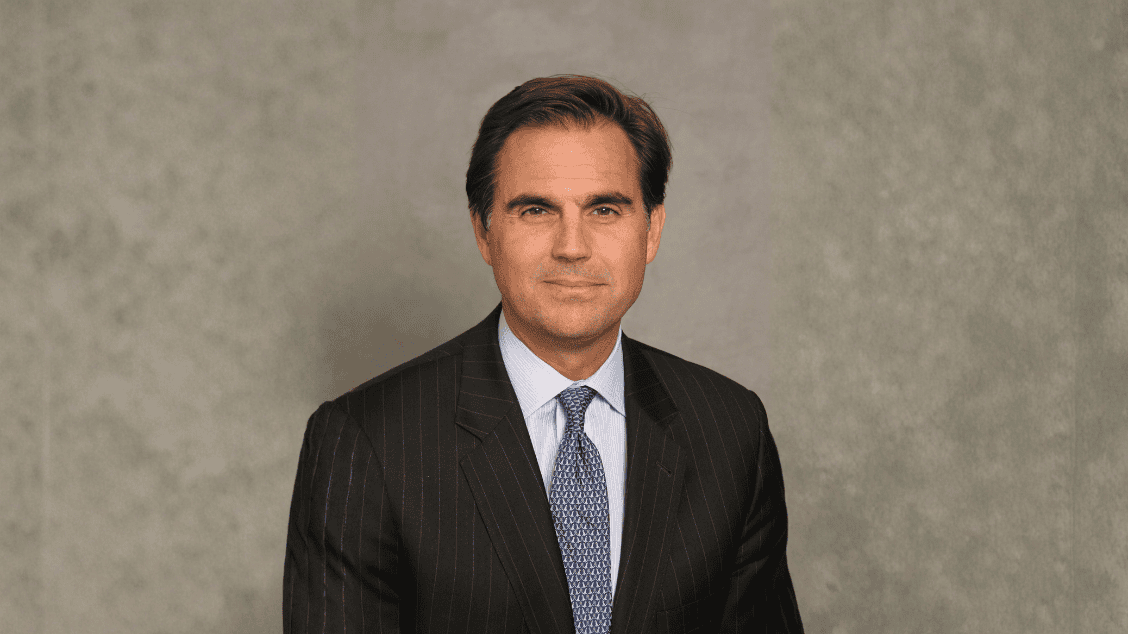


David Frame, global CEO of J.P. Morgan Private Bank—our Best Private Bank in the World winner—discusses how a client-centered culture continues to fuel growth even as technology and AI take an increasingly central role in wealth management.
Global Finance: As the wealthy continue to grow their fortunes, their demand for highly personalized services also rises—increasing the cost per client for banks. How is J.P. Morgan addressing this challenge?
David Frame: Personalization is at the heart of our value proposition. We constantly strive to make every adviser operate like our best and to make every client feel like our only one. By putting advanced digital tools in the hands of our clients and advisers, we’re able to deliver tailored advice and real-time insights at scale. Increasingly, AI and automation help us cut out complexity, reduce errors, and free up our advisers to spend more time with clients. At the same time, we invest in adviser training and local expertise to ensure that personalization remains authentic and impactful.
GF: A similar dynamic exists in financial data processing, especially as AI development and cloud adoption become more expensive. Do you see the solution in building internal data teams, acquiring specialized companies, or a combination of both?
Frame: It’s a combination. We’ve built a world-class team of 63,000 technologists, and we’re not shy about partnering or acquiring when it accelerates innovation. The 55ip and Global Shares acquisitions are perfect demonstrations of this approach. We responded to clients’ desire for tax-efficient, personalized, and automated investment solutions by integrating 55ip’s technology, making these capabilities widely available to our clients. With Global Shares, we can now reach and fully service executive clients globally. Our approach is to integrate best-in-class solutions while maintaining rigorous governance and security standards.
GF: Where do you see the greatest growth opportunities?
Frame: Growth opportunities exist across the wealth spectrum. Our platform, services, and institutional offerings were built for the ultrahigh net worth segment and have become an aspirational brand. We see significant potential in the emerging affluent and high-net-worth segments, especially as wealth transfers accelerate globally. These clients value access to insightful investment advice. The First Republic integration strengthens our ability to serve them with a differentiated offering that combines personalized service and scale.
GF: Beyond the ultra-affluent, the $10 million–$25 million segment is often seen as the next growth frontier. What distinguishes these clients, and how will you meet their needs?
Frame: Clients with $10 million to $25 million are a fascinating group. They’re entrepreneurs, business owners, and rising family leaders, who want sophisticated advice quickly and efficiently. They’re looking for institutional-quality investments, holistic planning, and lifestyle services, delivered digitally and seamlessly. Our answer is to combine our global scale with personalization—leveraging technology, AI-driven insights, and a full suite of solutions from alternatives to family office services. Clients in the $10 million to $25 million segment today will be in the $25 million to $50 million segment in the next 10 years. By staying flexible and innovative, we’re able to support this dynamic group of clients as their needs evolve, helping them achieve their goals at every stage.
GF: As wealth transition becomes increasingly important in private banking, meeting the needs of younger clients is key. What do you see as the most critical demands from this segment?
Frame: Next-gen clients want more than financial advice; they want purpose-driven guidance. Education, networking, philanthropy, and impact investing are top priorities. We’re addressing this with bespoke client events—like our 40×40 Conference, Next Generation Summer Series, and Emerging Family Leaders—that create spaces for learning and connection. Digital platforms give them real-time insights, while advisers guide them through succession, governance, and legacy planning. It’s about empowering them to steward wealth confidently and in line with their values.
GF: How do you evaluate whether technology is truly enhancing client relationships versus simply allowing advisers to manage more clients?
Frame: The metric is client engagement and satisfaction. Technology should support advisers in deepening relationships. We measure success by how effectively digital tools enable advisers to deliver personalized insights and proactive service. If technology helps us anticipate client needs and foster meaningful conversations, it’s working. Scale is important, but never at the expense of relationships.