
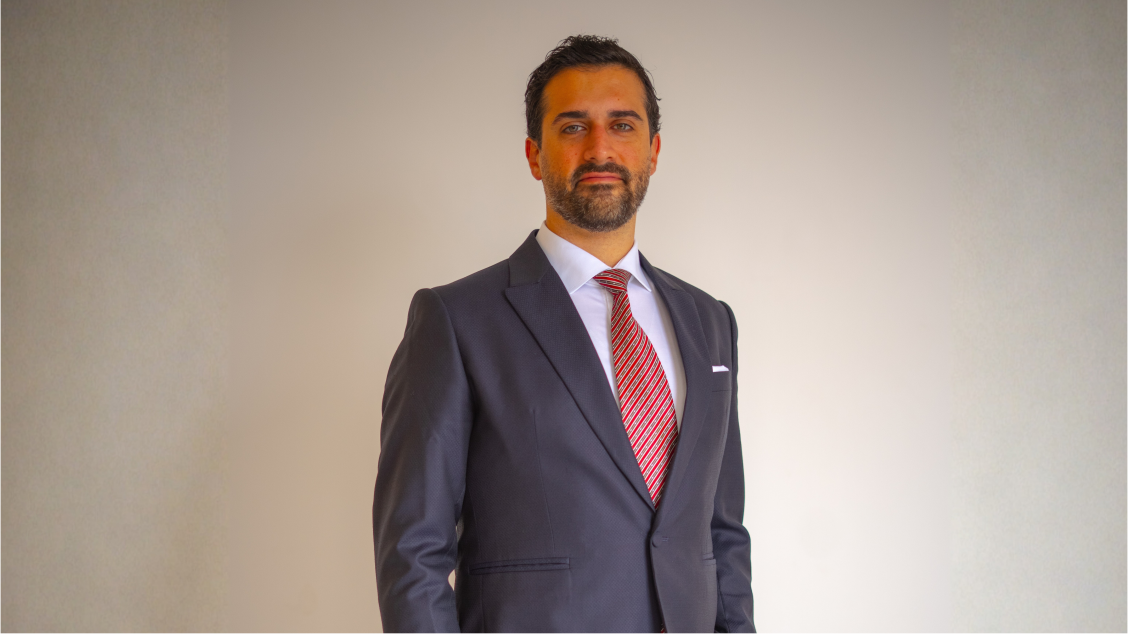


Aclara Resources in October announced a $277 million plan to build a first-of-its-kind US heavy rare-earth separation facility in Louisiana, part of a $1.3 billion investment in rare-earth mines and processing plants across the US and South America. François Motte, CFO of Chilean-based Aclara Resources, explains the company’s vertical integration model, the economics of competing with China, and how pre-launch offtake agreements help fund development.
Global Finance: Why is Aclara focusing on heavy rare earths rather than the broader rare earth market?
François Motte: Heavy rare-earth elements are scarce in the western world. They mostly occur in the southern provinces of China and bordering countries. That’s why China has 99% control of them, and that’s where the opportunity lies; there are deposits in Brazil and in Chile, and some found in Africa.
GF: The US signed a minerals deal with Ukraine earlier this year. Is this an area of interest?
Motte: You can find rare earths almost everywhere, but the real question is, is it concentrated in enough quantities to be economically viable? From what we have heard about Ukraine, there are not many occurrences and there needs to be a lot of exploration. We’re not interested in Ukraine. We are only interested in ionic clay projects, and these tend to occur in the southern part of China, Africa, and South America.
GF: You’ve chosen to vertically integrate the company from mine to alloy production. What drives that strategy?
Motte: We are trying to redefine what mining is. We are a spin-off of a traditional mining company, Hochschild Group, a precious metals company listed in London. Aclara’s mining is very simple. The minerals are superficial, 15 meters deep on average; it’s very simple to extract them with an excavator and trucks.
Our deposits [in Brazil] contain large quantities of heavy rare earths and very, very neglibible quantities of radioactive elements: uranium and thorium. Those have always been a problem for the industry, because they generate radioactive tailings that are difficult to permit and to handle.
Initially, when we introduced samples from our Brazil pilot, we found that the only true buyer was China. It didn’t make any sense for us to go to China after developing this new [approach], so we decided to vertically integrate the company and do our own processing.
GF: You’re constructing the $680 million Carina mine in Brazil and now establishing a $277 million separation facility in Louisiana. What’s the logic of splitting the work between these two regions?
Motte: It’s a matter of risk. First, the technology doesn’t exist in Brazil, and the people that we tapped to optimize the separation technology are in North America. We selected Louisiana as the location for our processing facility [because] the location was pre-certified by the state, and that meant permitting would only take eight to 10 months. We said, Okay, this is the place where we can actually go very fast. The reagents that we need for the processing come from the US, and they represent approximately 30% to 40% of the cost of processing. And our customers are in the US, at least a big portion of them. They want to be close to these processing facilities.
We are not saying that we’re not going to process in Brazil in the future. Due to the timing and the speed we need to institute our strategy, the best solution today is the US.
GF: The US government funded $5 million of Aclara’s Brazil project, and the company has suggested more government funding may be coming. How important is state support?
Motte: The US government—the Trump Administration—is extremely supportive of processing of rare earths in the US. That’s what the executive order makes clear.
GF: How do the economics of your operation compete with Chinese production?
Motte: We are not much more expensive from an operating cost perspective than China. I think we’re quite competitive on operating costs. The difference is in the initial investment. China, for example, has state support. They have zero cost of capital. The Chinese government supports projects with incentives. Between China and Western projects like ours, it’s not balanced.
What we need is to reduce the cost of capital as much as possible to be competitive. If my weighted average cost of capital is between 10% and 12% I’m already at a disadvantage compared to China. If I can reduce that as much as possible—to, say, 5% to 7%—you cannot imagine how much more competitive we become.
A customer says to me, what is the price you can give me? And we say, Look, if we need to finance this in the capital markets, the price that we can give you is this one. If we can tap into government funds with a much lower interest rate, I’m going to translate those savings into the price for the customer. Government funding doesn’t have to support the industry forever, but industry needs it at the beginning.
GF: Talk about managing geopolitical risk.
Motte: The relationship between the US and Brazil has kept us a bit nervous. We’ve all seen [Brazil’s President] Lula da Silva and [President] Trump not being on the friendliest terms. Although, they recently had a good meeting and now the US lowered tariffs, which signals a good relationship.
GF: Brazil and Chile have a history of nationalizing industry. Is this a concern?
Motte: In the case of Chile, it’s still too small of an industry to even think about. In the case of Brazil, we also don’t see it. We see more risk of pushing these mining projects to do processing locally, rather than nationalization.
What we tell the Brazilian government is two things. First, if they push these mining projects that are in the hands of junior companies to also do the processing in Brazil, they are going to increase the risk exponentially to the company. And that goes against the political [goal], which is bringing this mine into operation. There will be government investment in this; the Brazilian government wants to be a stakeholder. It’s in their main interest to be part of this critical mineral solution. We’re going to see that, but on a minority basis.
GF: Aclara has said that by 2028, it expects to supply over 75% of US demand for crucial rare-earth elements for electric vehicles. Your commercial strategy centers on securing offtake agreements with EV automakers. What’s the ask?
Motte: It has evolved, because the electric vehicles industry has also evolved in the last two years. There was a lot of hype 2, 3 years ago, and now there’s a deceleration. Despite this, demand will continue.
What we ask of automakers is a take-or-pay contract that at least covers the payback period of our investment. That usually is a contract that will take approximately 5 years. We are happy to renew it later for up to 10 years, but it will have a fixed price or floor price that allows us to reach that payback period during the term.
We used to ask for financing, we used to go out seeking investment, but we realized that the only thing we need from the final customer is a strong commitment. It’s signing that contract, which allows us to finance the projects, either through government loans or through investments and commercial debt. It also allows us to bring in new investors. That’s why I believe that offtake agreements are kind of the anchor.
GF: How do you find patient investors?
Motte: In our case, we have the Hochschild Group owning 57% of our company. We brought [Chilean mining company] CAP S.A. into the equation as a shareholder. CAP completed a $10.8 million investment early last year, acquiring approximately 10.18% of Aclara’s share capital. It was not easy to select them; we were looking for a company that wanted to invest in this for the future, that didn’t want to just come in and sell it in two, three years. It’s not easy to find those types of investors that commit to a smaller project like ours.
It’s a way to counterbalance the volatility. Having long-term shareholders has allowed us to deploy this vision, during good times like now and bad times like three to four years ago, when there was much less interest. We were investing significant money and advancing very fast.
GF: Aclara is betting big on EVs. Does this keep you up at night?
Motte: I think we have the right strategy. We have the right vertical integration. I think we manage political risk. What keeps me up at night is the commercial front; it’s very challenging competing with China.
The Chinese product—whatever you want to say on the environmental or the social front—is very reliable. [Automakers] receive a very good product in the quantities they require at the time they require, at a very affordable price. What keeps me up at night is, if a commercial agreement is not signed, how am I going to finance this? We must finance approximately $1 billion for Brazil and Louisiana.
If you ask, How much time do you put into all your tasks? I would say on the commercial front, 50% of my time. That’s where I’m very, very focused now: bringing the customers to the pilot plants to see the technology, to see that what we’re doing is first class, to know our shareholders, to show them that we are not just a junior company, but we’re backed by very important industrial companies with very long experience in mining, especially in South America.