

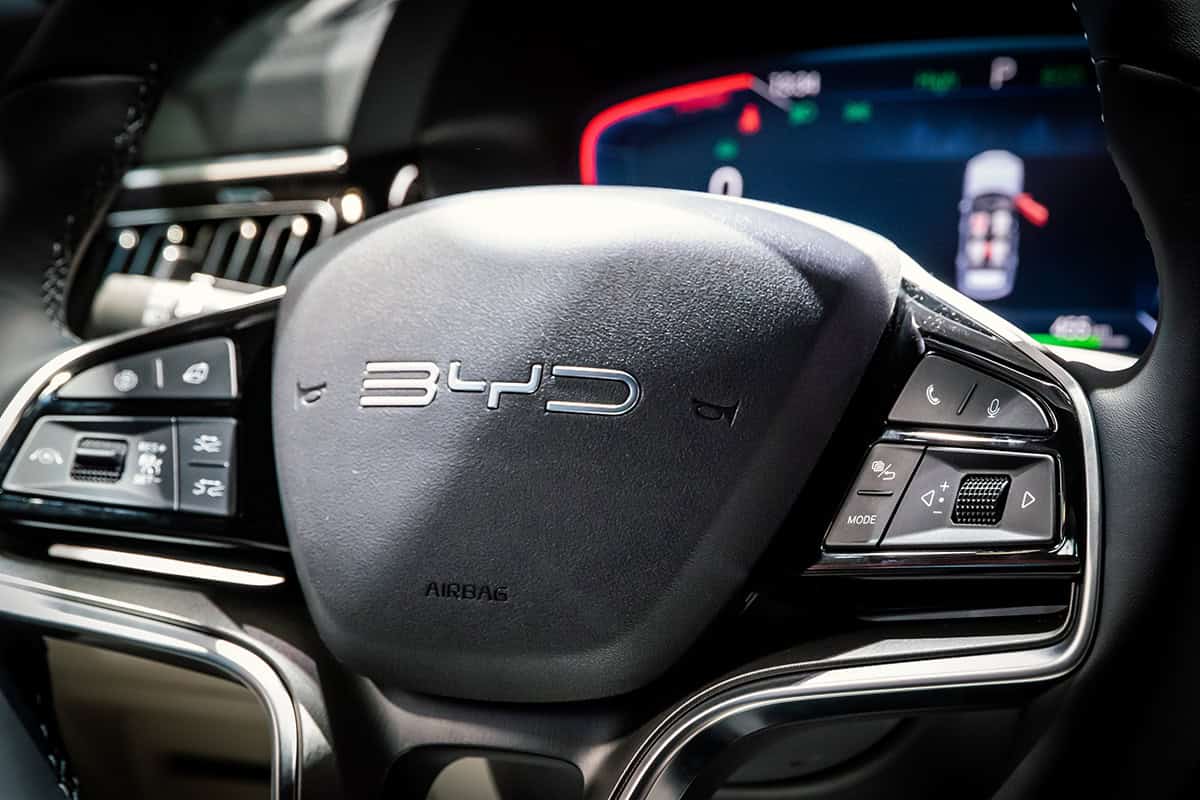


Ford is weighing battery talks with China’s BYD to fuel its hybrid and extended-range push—sparking backlash from U.S. lawmakers.
After taking a $19.5 billion charge to end production of electric vehicle (EV) lines including the Ford F-150 Lightning, Ford Motor Company has reportedly entered talks to source batteries from leading global EV manufacturer BYD for hybrid and extended-range EVs (EREVs). Hybrids and EREVs use a gasoline-powered engine to power onboard batteries.
The story has raised concerns with US lawmakers.
“If reports that Ford is in discussions to potentially partner with a second Chinese battery company were to come true, it would diminish Ford’s status as an iconic American company,” Rep. John Moolenaar (MI-R), who chairs the House Select Committee on Strategic Competition between the United States and the Chinese Communist Party, told Bloomberg in a statement.
Even Peter Navarro, senior counselor to the president for trade and manufacturing, commented on the reports via social media.
“So Ford wants to simultaneously prop up a Chinese competitor’s supply chain and make it more vulnerable to that same supply chain extortion?” he asked via his X account. “What could go wrong here?”
Ford has an existing deal with the Chinese battery manufacturer Contemporary Amperex Technology, and already has a relationship with BYD to supply batteries to its Chinese joint venture with state-owned Changan Automobile.
Despite downsizing its EV manufacturing, Ford executives expect their Universal EV Platform, which will underpin several of its models, can only grow in demand. The carmaker anticipates that 50% of its global volume will be in hybrids and EREVs by 2030, up from today’s 17%.
Ford remains coy about its plans with BYD, however, releasing a statement to Reuters last month saying, “We talk to a lot of companies about many things.”
Any deal reached by Ford and BYD is likely to be for overseas production and sales, since current US tariffs make BYD products prohibitively expensive for domestic US consumption.
To put the Dearborn automaker in an even less advantageous position, it fell behind BYD in global vehicle sales in 2025. Ford reported in early February that its total sales dropped by approximately 2% to slightly more than 4.4 million vehicles, compared with the roughly 4.6 million vehicles BYD reported in January, Bloomberg reported at the time.