
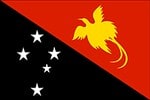
Includes historical data for Papua New Guinea’s Gross Domestic Product growth, debt-to-GDP ratio and more, as well as information on trade, banking and financial sector leadership.
Agriculture And Minerals Dominate The Economy
With an estimated population of about 12 million, the Independent State of Papua New Guinea in the southwestern Pacific Ocean is the world’s third-largest island country. One of the most culturally diverse nations globally with over 800 languages spoken, and home to an estimated 5 to 7% of the world’s tropical rainforest, its economy is dominated by two main broad drivers: the agricultural, forestry and fishing sectors on one hand, and the minerals and hydrocarbons extraction industry. A member of the Commonwealth and of the Asia-Pacific Economic Cooperation (APC), its economy is projected to grow by over 4% throughout the decade.
However, challenges to growth are significant, including a sizable informal sector centered around subsistence farming and a lack of skilled labor, poor governance, and inadequate infrastructure.
Macroeconomy & Sovereign Data
| Type of Government | Parliamentary democracy (National Parliament) under a constitutional monarchy; a Commonwealth realm |
|---|---|
| Capital | Port Moresby |
| Sovereign Ratings |
S&P: B– Moody’s: B2 Fitch: B- |
| Total Population | 12.8 million |
| Median Age | 22.8 |
| Adult Per Capita Income (PPP) | 7,795.54 |
| Total GDP (2025) | USD 32.7 billion |
Papua New Guinea GDP & Economic Overview
Most Recent Content
Papua New Guinea
Emerging & Frontier Markets
Features : New Breed of Tigers Begins To Roar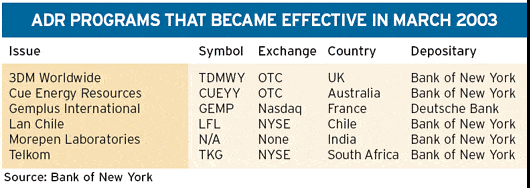
Capital Raising & Corporate Finance
Corporate Finance : 3DM Worldwide Issues ADRs Instead of Listing…Banking & Finance
Trade & Investment
| Total Exports | USD 9.7 billion (2024) |
|---|---|
| Leading Exports |
Natural Gas Gold Copper Ore Palm Oil Nickel |
| Total Imports | USD 6.3 billion (2024) |
| Leading Imports |
Refined Petroleum Rice Trucks Excavation Machinery Plastic Products |
| Source: | IMF, CIA The World Factbook |
Papua New Guinea Leading Companies
| Bank South Pacific (BSP) | Financials |
|---|---|
| Kina Bank Limited | Financials |
| National Petroleum Company of Papua New Guinea (NPCP) | Energy, Oil & Gas Exploration & Production |
| Oil Search Limited | Energy, Oil & Gas Exploration & Production |
| Morobe Mining Joint Venture (MMJV) | Materials, Metals & Mining |
| Steamships Trading Company | Consumer Staples, Food Distribution |
Major Trade Partners — Import
| Australia | 35.6% |
|---|---|
| China | 17.4% |
| Singapore | 15.1% |
| Malaysia | 6.4% |
| Indonesia | 4.22% |
Major Trade Partners — Export
| Japan | 22.59% |
|---|---|
| China | 18.18% |
| Australia | 17.35% |
| Other Asia | 7.15% |
| Singapore | 6.61% |
Global Finance Rankings & Awards



Data Sources:
UN World Population Prospects
World Inequality Report
S&P Global Ratings
Moody’s
Fitch Ratings
IMF Direction of Trade Statistics (DOTS)
UN Conference on Trade and Development (UNCTAD)
CIA The World Factbook
World Bank’s World Integrated Trade Solution
Forbes Global 2000