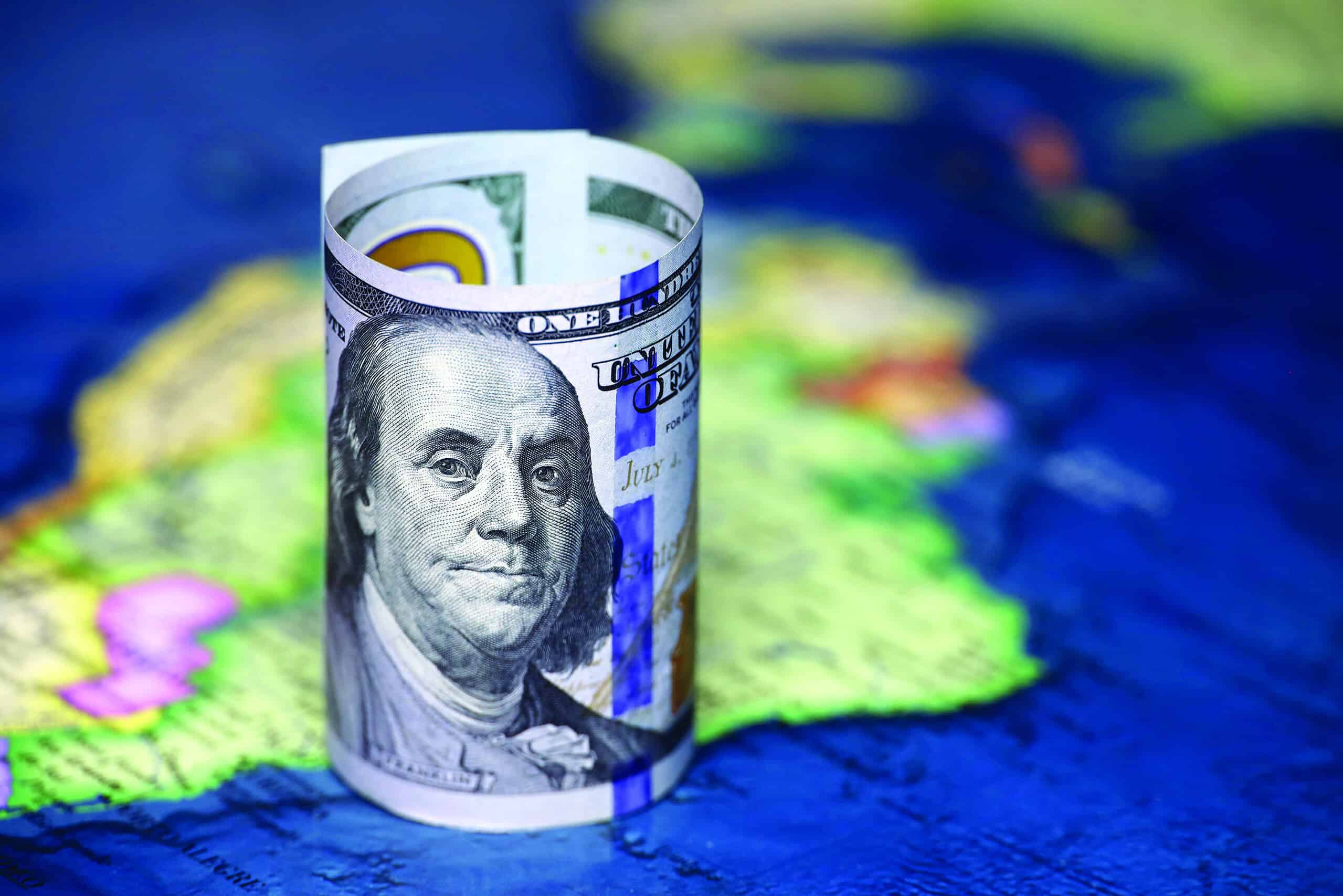


As Latin America turns to the dollar, development capital tests its reach.
This article appears in the October issue of Global Finance Magazine.
Whether dollarization works has been debated for decades, and in late summer it landed in Venezuela. Steve Hanke, known as the “Money Doctor” for advising governments on dollarization in Eastern Europe, Asia, and Latin America, told multiple media outlets that he had been hired as a special adviser to a Venezuelan official to explore dollarizing the bolivar.
If it converted to the dollar, Venezuela would join several Latin American countries that have done so. Panama has used the dollar as legal tender since 1904. Ecuador has used the dollar since 2000; El Salvador converted in 2001. Although Argentina has not dollarized, there is evidence that President Javier Milei has accelerated its de facto shift to the dollar. Less examined is which organizations are investing in dollarization—and whether that capital is doing something dollarization alone can’t.
For CFOs with projects, suppliers, or growth aspirations in dollarized countries—or those moving that way—the balance sheet is the best way to assess the role of development capital. A currency conversion can affect hedging costs, discount rates for capital projects, and the timeline for moving cash. But the money now supporting these transitions or future moves to dollarization, including billions in US development-finance capital, political risk insurance, sovereign debt refinancing, and project loans, carries its own track record worth mulling over before using “dollarized” as shorthand for “de-risked.”
Where Development Capital Lands
The International Development Finance Corp.’s (DFC) Latin American strategy is more than writing large checks. Its CEO Ben Black calls the strategy “economic statecraft”—capital deployed to counter Beijing. “You don’t want to compete against state capitalism with more money from the government,” Black said at a March forum. “You want to create capital structures that bring in private capital.” In Ecuador, where the U.S. dollar is legal tender, the agency’s 2021 framework was linked to a proposed, broader $3.5 billion financing structure. It combined up to $2.8 billion of potential DFC-backed project financing with roughly $700 million from commercial banks, intended to help Ecuador refinance China-related liabilities.
The agency’s completed transactions are more varied. DFC made a $150 million direct loan to expand Ecuador’s Puerto Bolívar port. It also provided political-risk insurance of more than $656 million for the 2023 Galápagos debt conversion and $1 billion for the country’s 2024 Amazon Biocorridor conversion. The latter helped refinance about $1.53 billion of Ecuadorian international bonds. For CFOs looking through a balance sheet lens, Puerto Bolívar is a DFC loan asset. The two larger headline amounts are insurance commitments that could help attract third-party capital.
In Argentina, where dollars are widely used but not the official currency, DFC’s financing is smaller and tied to resource development. The agency approved $4.07 million for early-stage work at Argentina Potash Corp.’s El Ceibo potash project earlier this year. The company expects more dollars to follow. “The US$4.07 million DFC funding is expected to be matched dollar-for-dollar by strategic investors, resulting in total Phase 1 funding of US$8.15 million,” according to a company statement.
Leading Risk vs. Following Money
The Argentina Potash deal points up a divide over where development finance has the most impact: taking risks that private capital won’t or reinforcing markets where private capital is already willing to go. DFC and its defenders argue that the capital leads: the agency takes on risk private investors won’t touch and proves out a sector or structure until commercial capital is comfortable following. Another group argues DFC capital mostly follows. Its development dollars tend to land in the safest, most liquid corners of an economy, such as banks, infrastructure and assets that would likely have attracted private capital anyway.
The harder, riskier investments that dollarization was supposed to encourage still go unfunded. If development capital leads, it’s doing something dollarization alone can’t. It is building the risk tolerance and track record that pulls in private money on its own. If it mostly follows private capital, DFC funding may simply be competing for the safest returns, while the risks that keep money out of harder-to-finance sectors remain.
That’s the view of Byron Villacis Cruz, a University of Oregon sociologist and former head of Ecuador’s national statistics institute, who has studied Ecuador’s dollarization. He said DFC-linked capital has gone toward “traditional banks that … have a lot of liquidity and coverage and stability by itself” rather than higher-risk, higher-need sectors.
“I don’t see investments that are truly analyzing the real opportunities of profit and development in the country,” he said. “That’s kind of like going where the money is versus leading the money.” He also cautions that dollarization solved currency volatility in Ecuador without touching the risks investors cite—regulatory whiplash, contract enforcement and political interference. Foreign investment after 2000 flowed overwhelmingly into oil, he noted, driven by commodity prices, not the new monetary regime.
Casey Halloran has a different view: his tourism and real estate development company, Namu Travel Group in Costa Rica, borrows from the Inter-American Development Bank specifically to relend to small suppliers—boutique hotels and tour operators across the region—that banks often consider too risky to touch. Over the years, Halloran estimates his business has lent about $15 million since first obtaining IDB financing. He’s convinced development capital leads, saying, “Somebody has to go first.”
Weld Royal is a contributing writer based in the U.S.