

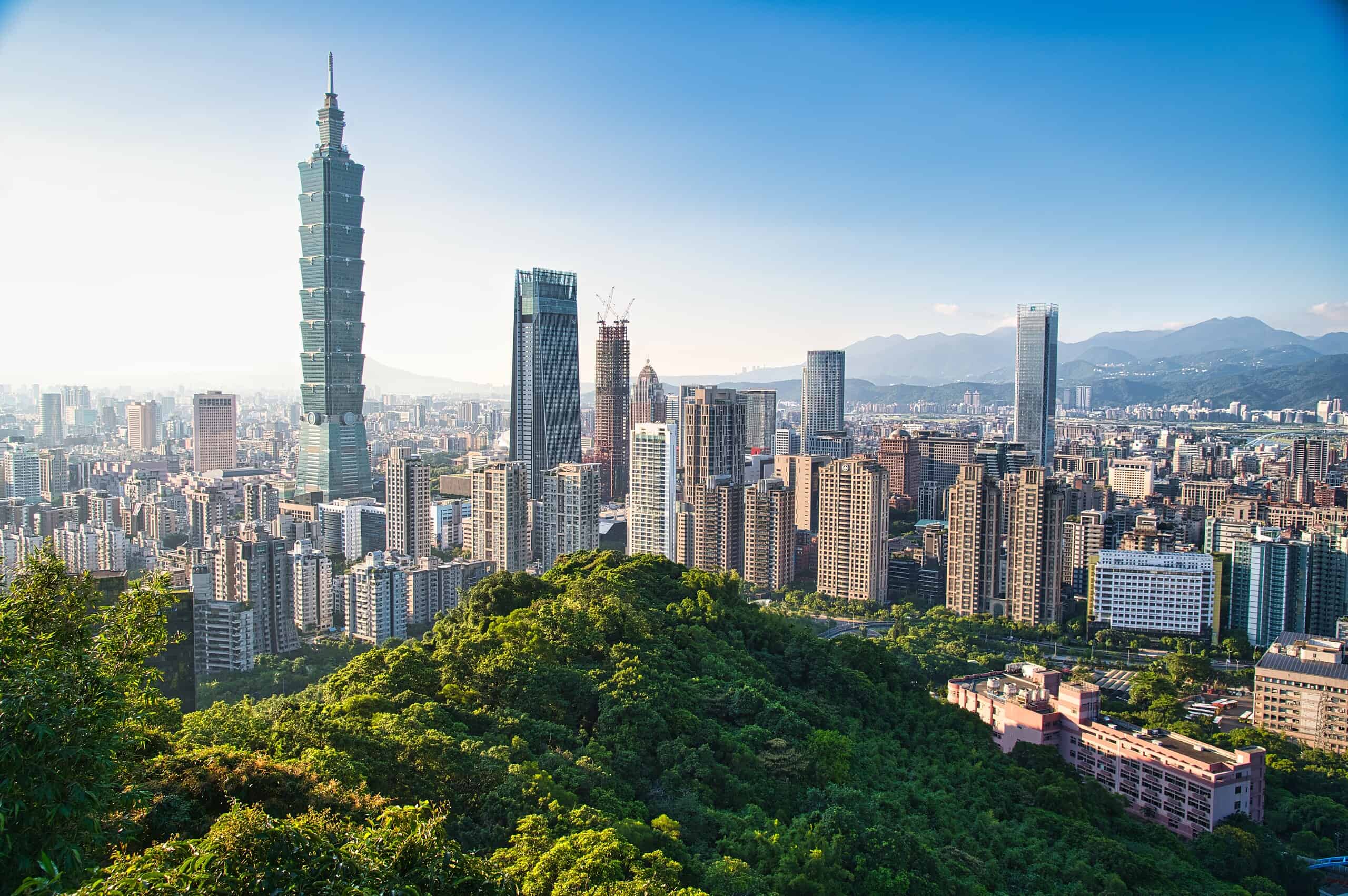


Taiwan’s booming economy looks to continue its growth, but heavy dependence on semiconductor exports is prompting concerns.
| VITAL STATISTICS |
|---|
| Location: North Asia |
| Neighbors: China, the Philippines |
| Capital City: Taipei |
| Population (2025): 23.2 million |
| Official Language: Mandarin Chinese |
| GDP per capita (2025): $39,000 |
| GDP growth rate (2025): 7.71% |
| Inflation (2025): 1.66% |
| Currency: New Taiwan dollar |
| Investment Promotion Agencies: Ministry of Economic Affairs (MOEA), Department of Investment Promotion (DOIP), Bureau of Industrial Parks (BIP) |
| Investment incentives: Streamlined approvals; dedicated project managers for projects over NT$500 million ($15 million); R&D tax credits; investment tax credits up to 25% on investment in key supply chains or advanced processes; location-based incentives in science parks, industrial parks, and free-trade zones; relaxed visas for talent attraction, including the Employment Gold Card program for skilled talent |
| Corruption Perceptions Index rank (2024): 25/180, where 180 is most corrupt |
| Political risks: The administration of President Lai Ching-te faces an opposition-controlled legislature that often blocks budget proposals, risking policy paralysis or destabilization in the face of Chinese interference |
| Security risks: Potential for naval blockade, military attack, or full-scale invasion by China |
No other developed market has demonstrated the impact of AI and high-performance computing booms more dramatically than Taiwan. And the data suggests that these booms are not about to turn to bust anytime soon, despite fears of overheating and a decline in external demand for Taiwan’s exports.
A forced unification with China might render it a no-go area for numerous investors. But ignoring that wildcard scenario, there is no escaping the fact that Taiwan is now a lynchpin of the global supply chain and, by extension, the global economy, as well as a significant destination for investment and trade: the latter being a position on which the island’s economy and its 23.2 million population depend.
Taiwan sits at the center of the global hi-tech supply chain thanks to its pre-eminence in semiconductor manufacturing, AI, and 5G telecommunications. Thanks to investment incentives and an environment fully open to growth and cooperative opportunities, the island is a magnet for foreign direct investment (FDI), led by the Netherlands and followed by the US, which held $19.3 billion in FDI as of 2023.
FDI is critical, given Taiwan’s self-imposed debt ceiling and the cap it imposes on public spending. The Department of Investment Promotion provides streamlined services to foreign investors in a bid to boost FDI, making dedicated project managers available for investments above $15 million and R&D subsidies.
Still, some international investors worry about the dominance of Taiwan’s state-owned enterprises, claiming they distort fair-market practice and lack regulatory transparency.
That said, Taiwan stunned with full-year 2025 GDP growth of 7.71%, an upward revision from the initial 7.63% estimate in January by the Department of Statistics and a figure that wrongfooted all but a handful of economic forecasters.
That result marked Taiwan’s fastest pace of economic expansion in 15 years and smashed forecasts from the likes of the International Monetary Fund and the Asian Development Bank, which ranged from 2.9% to 5.1% for 2025 when the year kicked off.
Last year’s economic performance was superlative across the board, boosted by a tidal wave of global demand for the AI-related exports that power Taiwan’s economy, notably semiconductor manufacturing capacity that has propelled the island from developing to developed status in less than a generation.
Exports surged by 35%, quarterly growth in the last three months of the year was an eye-popping 12.68% year-on-year—the highest in 38 years—and stocks advanced strongly, pushing the TAIEX into the global top 10 by market capitalization early this year as the index hit a 100 billion New Taiwanese dollars ($32 billion) valuation for the first time.
Excessive Concentration?
| PROS |
|---|
| Preeminence in global semiconductor supply chain |
| Foreign investor-friendly policies, including numerous incentives |
| Low domestic interest rate and inflation |
| Strong correlation of growth and investment with the global AI boom |
| Political stability |
| Strong official institutions |
“We have upgraded our GDP growth forecast for this year to 6%, which is a totally crazy rate for a developed economy,” says Alicia Garcia-Herrera, chief economist for Asia Pacific at French finance giant Natixis in Hong Kong and a senior fellow at the Brussels-based economic think tank the Bruegel Group.
“Bear in mind Japan grew last year by just 1.1%,” she added. “A milestone indicator of the country’s economic success has been its overtaking both Japan and South Korea in terms of GDP per capita, which hit $39,477 last year.”
The fly in the ointment, Garcia-Herrera notes, is that growth is concentrated in the semiconductor sector “and its ancillary industries such as packaging, which are all dependent on demand from that one single sector.”
Taiwan’s focus on exports, particularly semiconductors, has provoked grumbles that the basic stance of the Central Bank of the Republic of China is to keep the Taiwan dollar artificially low, crowding out other domestic industries and exposing the economy to concentration risk via dependence on tech-related exports.
| CONS |
|---|
| Geopolitical tensions with China |
| Overexposure to the global AI boom |
| Risk from excessive capex spending related to AI |
The currency dramatically strengthened against the dollar in May, down to 28.85% as the result of inbound investment flows and generalized the dollar’s weakness versus other Asian currencies.
The new Taiwan dollar subsequently weakened as the result of reported central bank intervention, to stand in late January at 31.7 to the dollar and renewing the view that the currency is artificially undervalued. Rates are ultra-low across the yield curve for government bonds, which range from 1.21% for two-year to 1.43% for 10-year issues, anchored by a 2% policy rate.
In this context, a remarkable feature of last year’s growth was the absence of overheating in the economy, with the CPI at just 1.66%, allowing the central bank to hold the policy rate steady: a stance it is expected to maintain this year.
“The strong concentration on exports leaves the economy vulnerable to a slowdown in its key trading partners and reduced global AI demand,” cautions Sagarika Chandra, director of APAC sovereigns at Fitch Ratings in Hong Kong. “Taiwan’s electrical equipment exports as a share of total exports are relatively large, at around 43%, and weaker demand for such exports is likely to have a substantial negative impact on growth through lower exports.”
FDI Surges
Inbound and outbound FDI has played a significant role in Taiwan’s economic trajectory. The former surged 44% last year, to $11.39 billion, driven by technology and services, including semiconductor manufacturing, AI, renewable energy, and financial services. Investment incentives available for inbound FDI include special tax treatment and set-up support from Invest Taiwan, a government agency.
Mainland China has dominated inbound FDI recent years, but as Taipei seeks to strengthen economic ties beyond its neighbor into Southeast Asia and the US, inbound FDI from the mainland shrank by 65.4% last year.
As Taiwan shudders at the prospect of the Trump administration slapping tariffs on its semiconductors the island has committed to its biggest-ever outbound FDI undertaking, the construction of a $250 billion semiconductor manufacturing plant in the US by Taiwan Semiconductor Manufacturing Corporation (TSMC). In return, Taiwan is to receive a tariff exemption on microchips and a reduction in overall tariffs on other products.
Observers doubt the manufacturing shift will prove a significant liability.
“The offshoring of semiconductors, in my opinion, is not a big problem for the country,” says Garcia-Herrera, “because if Taiwan continues to serve all that global demand from Taiwan, all the resources will only go to the semiconductor industry, whether it’s green energy, water, the best talent, you name it. So offshoring is a good idea, because it frees up domestic resources.”
In 2026, Fitch expects the economy will continue to benefit from the increased production and investment by some advanced AI chip producers, even if there is some moderation in demand, according to China. We expect the US–Taiwan trade agreement, which reduced tariffs to 15% from 20% previously, could offer near-term relief for Taiwan’s semiconductor export-driven economy, creating a more level playing field for key export sectors.”
More concerning, Taiwan is extremely dependent on energy imports: almost 98%, according to data from the US Energy Information Administration. That’s an alarming figure given the needs of the island’s energy-intensive tech sector and its vulnerability to a potential naval blockade. Renewable energy is therefore expected to be a more significant variable in Taiwan’s economic trajectory.
It has a long way to go. Just 12% of the 288 terawatt hours the island generated in 2024 came from renewables, with the bulk coming from natural gas (42%) and the rest from coal (39%) and nuclear power (4%). But this could present an opportunity for further FDI.
“Renewable energy will be vital for Taiwan’s economic development regarding the decarbonization trend and compliance requirements from the international value chain, especially the semiconductor industry,” points out Ching-Wen Huang, director for renewables and sustainability advisory at sustainability consultancy NIRAS. “Taiwan has a relatively open renewable energy market for foreign companies,” he says, “and the government is truly welcoming foreign investment and corporations in the development and supply chain.


