
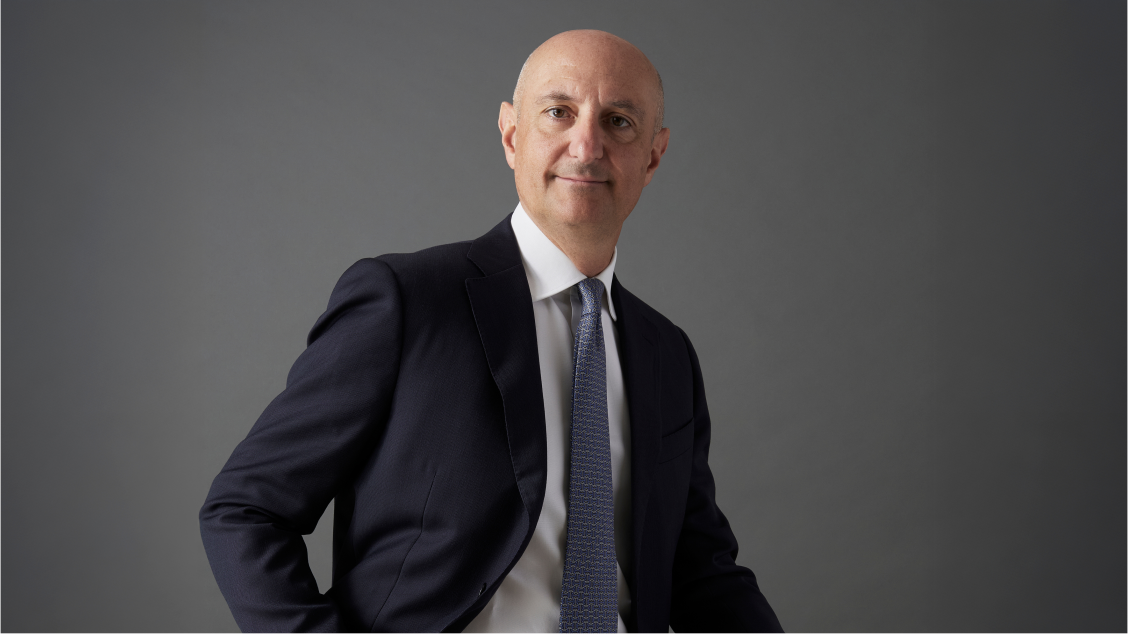


Stefano Palmieri, CFO of Comer Industries, discusses navigating growth, acquisitions, and managing a multinational company with strong family ownership.
Global Finance: What has been your biggest challenge since joining Comer Industries?
Stefano Palmieri: After I joined in 2021, Comer experienced significant growth, marked by the acquisition that year of the German group Walterscheid [a supplier of powertrain systems for agricultural, construction, and other off-highway vehicles and machinery], which had revenues of around €400 million, roughly equal to Comer’s size at the time.
For a company with no prior experience in large-scale acquisitions, integrating such a complex business was a major challenge for the executive team under the CEO’s leadership. Substantial value was created through footprint optimization, plant consolidation, a more balanced global production base, new customer contracts, and operating cost synergies. Supported by favorable market conditions, we closed 2023 with revenues of €1.2 billion and EBITDA exceeding €200 million.
From a financial standpoint, the main challenges were integrating finance teams and cultures, generating rapid cash flow to repay the acquisition and implementing the processes needed to transform Comer into a truly global multinational.
GF: Why is it important to have a wide geographic footprint?
Palmieri: Our footprint spans multiple geographies: Europe, with headquarters and core operations in Italy and a production hub in Germany; the US, where we consolidated three manufacturing sites into one near Chicago; India, with a sizeable facility in Bangalore; China, with a large plant in Shanghai; and a smaller presence in Brazil and, since January, in Japan and Thailand.
This global footprint reflects customer demand for manufacturing close to their assembly lines as we produce large, heavy components for leading agricultural and construction equipment manufacturers such as CNH, John Deere, AGCO, Caterpillar, and Komatsu. A flexible worldwide production network enables us to respond quickly to customer needs and manage volatility—now the new normal—by shifting production to optimize total costs amid logistics disruptions, tariffs, and other market challenges.
GF: What are the key challenges of managing a multinational group?
Palmieri: Human relationships remain central to our culture; we are a people-driven company that believes value and culture are best transmitted through direct interaction. We actively promote international exchange, sending people and often youth abroad and bringing colleagues to Italy to blend cultures and share best practices.
This approach is reflected in our most recent move. Early this year, we acquired a majority stake in Nabtesco’s hydraulic equipment business, with €270 million in revenues, adding about 800 colleagues, half in Japan and the rest in China and Thailand. The deal was made possible by a long-standing partnership dating back to 2017 and a strong cultural fit, particularly around discipline and shared production philosophies such as the Toyota Production System and World Class Manufacturing.
Cultural and language barriers remain, but the alignment on processes and values has made integration feasible and promising.
GF: Comer is a publicly listed company, with the Storchi family owning 51%. How does this mix of public and family ownership shape the way the group is managed?
Palmieri: One of the company’s greatest strengths is the commitment of its leadership: specifically, our chairman and CEO, Matteo Storchi, who leads the company on behalf of the founding family. This creates a unique combination: an entrepreneurial CEO with the authority and long-term perspective of an owner. Unlike many publicly listed companies, where CEOs are often driven by short-term results, this structure enables bold decisions and a medium- to long-term vision.
This approach proved critical after our 2023 record year, when revenues declined by more than €300 million over two years. While we took decisive cost-cutting and efficiency measures to protect margins, we continued to invest: acquiring a US plant, advancing discussions in Japan, and laying the groundwork for future growth