
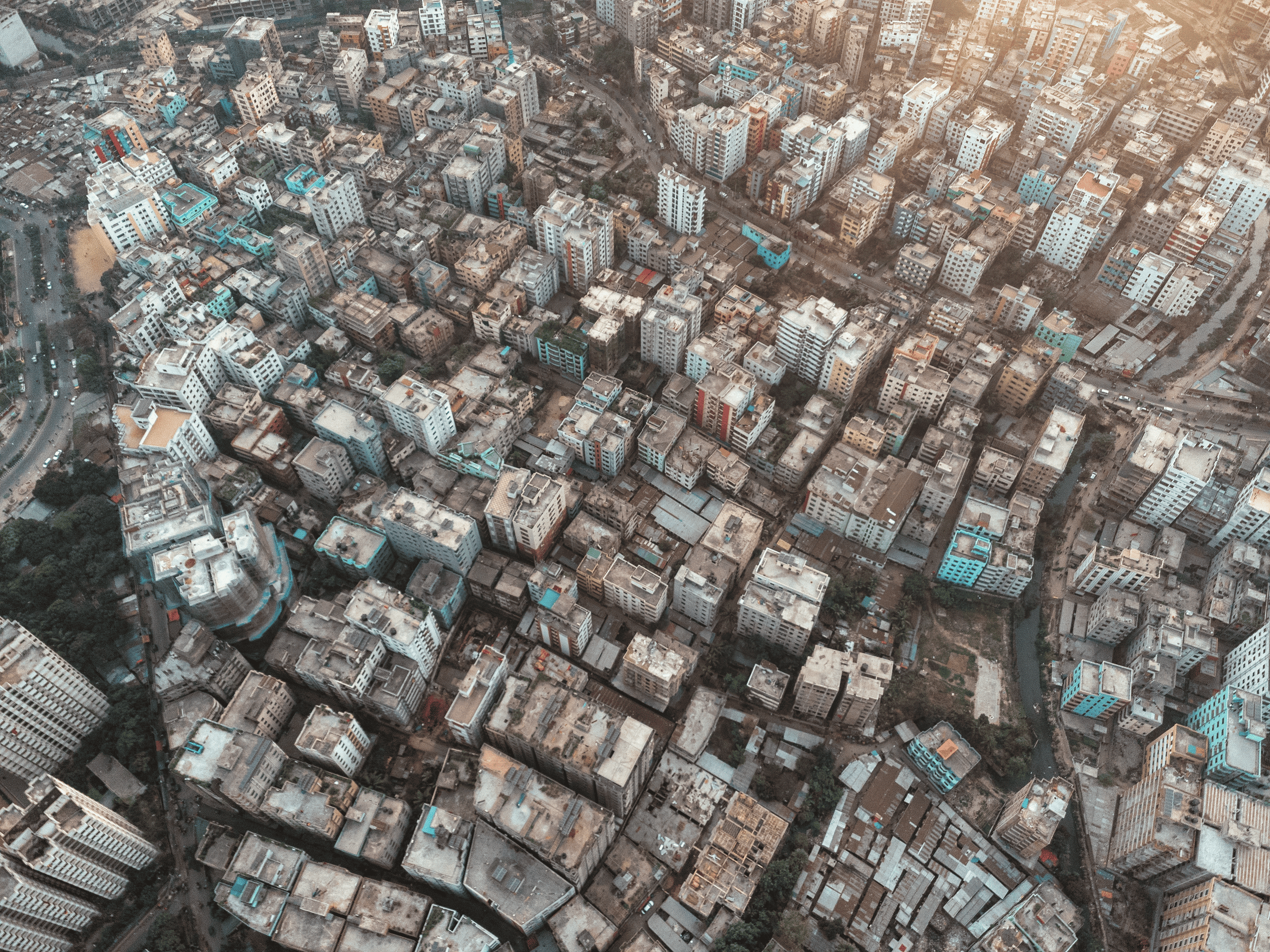


Bangladesh, after decades of demographic growth and political upheaval, faces challenges diversifying beyond its over-reliance on the garment sector.
| VITAL STATISTICS |
|---|
| Location: South Asia |
| Neighbors: Shares land borders with India and Myanmar |
| Capital City: Dhaka |
| Population (IMF projection 2026): 175.42 million |
| Official language: Bengali (Bangla) |
| GDP per capita (current US$) (2024): $2,593 |
| GDP (current US$) (2024): $450 billion |
| GDP growth rate (provisional FY2025) 3.97%; forecast (2026): 4.9% |
| Inflation (November 2025): 8.29%; forecast (2026) 8% |
| 2024 unemployment rate (estimate): 4.7% |
| Currency: Taka |
| Investment promotion agency: Bangladesh Investment Development Authority (BIDA) |
| Investment incentives: All incentives require prior registration with the BIDA and subsequent approvals from relevant bodies including the National Board of Revenue (NBR). Industries must register with the BIDA to qualify for corporate income tax (CIT) exemptions, holidays (typically 5-10 years), or rebates, varying by sector and location. CIT exemptions and holidays are subject to NBR approval. Import duty exemptions on capital machinery and spare parts require BIDA registration and approval from the chief controller of imports and exports, primarily for export-oriented or approved projects. An accelerated depreciation allowance is permitted for plants and machinery in newly established industries. |
| Corruption Perceptions Index (2024): 151 (out of 180 countries) |
| Credit rating: B+ outlook stable (Fitch Ratings) |
| Political Risk: Tarique Rahman won victory in the recent Bangladeshi elections; risk of violence, crimes, and targeted killings. |
| Security risk: Crime and violence instigated by hardline Islamist and extremist groups, abusive state security forces. Bangladesh hosts one of the world’s largest refugee populations, around 1.16 million Rohingyas. |
Bangladesh was classified as one of the Next Eleven emerging markets by Goldman Sachs in its 2005 paper, “How Solid are the BRICs?” But after two decades, and despite a demographic dividend, the country has not achieved its full potential.
The South Asian nation boasts the world’s eighth-largest labor force, totaling 77 million, with women comprising 36.9% of the total and half the population under age 30.
However, this demographic dividend has fueled frustration rather than opportunity. It sparked the July Revolution protests of early July 2024, which targeted the controversial job quota system, corruption, and the authoritarian rule of Sheikh Hasina’s government; some 1,400 people were killed amid riots nationwide.
Hasina resigned on August 5, paving the way for an interim government led by economist and microcredit pioneer Muhammad Yunus as chief adviser. The upheaval triggered a severe financial and political crisis, amid which Bangladesh signaled its intent to seek a $3 billion augmentation to its program from the International Monetary Fund.
The IMF already approved a $4.7 billion extended credit facility (ECF) the previous year. It later extended the program further, approving an additional $884 million. As of last month, the IMF has cumulatively disbursed $4.1 billion across all tranches.
Last November, the IMF praised Bangladesh’s interim government for progress in macroeconomic stability and reforms while noting ongoing challenges, including financial vulnerabilities. The World Bank projects 4.8% GDP growth for the 2026 financial year while the IMF forecasts 4.9%.
From the foreign investors’ perspective, much will depend on the outcome of this month’s parliamentary elections, which will include a referendum on a new national charter. Under Yunus’ interim government, however, change is already underway.
Fostering Diversification
After four decades, ready-made garments (RMG) and textiles remained Bangladesh’s top export earner in fiscal 2025, reaching a record $39.4 billion. The industry employs 4 million workers and ranks as the world’s second-largest apparel exporter after China. The US is its largest single-country market and the EU leads the regional blocs.
While the RMG sector’s contribution is impressive, non-RMG businesses lag, and the World Bank, UNCTAD, and Asian Development Bank (ABD) are calling for reducing RMG concentration.
“Bangladesh remains heavily dependent on the RMG sector, which accounts for over 80% of export earnings,” says Shahanur Islam, founder and president of JusticeMakers Bangladesh. “While this sector has been the backbone of economic growth and employment for decades, overreliance on a single industry exposes the economy to global demand shocks, compliance pressures, and supply chain disruptions.”
Risks from RMG concentration are already materializing via three immediate challenges. A 36% tariff burden imposed by the US is already turning up the pressure, automation in the textiles sector has raised unemployment, and Bangladesh risks losing duty-free, quota-free EU market access upon graduating from least developed country (LDC) status, likely eroding RMG competitiveness.
“Bangladesh is set to graduate from LDC status in November,” notes Hoe Yun Jeong, country director, Bangladesh Resident Mission at the ABD.
“For a stronger economic future, the country needs to move beyond its low-wage model. Growth should pivot towards productivity and innovation, particularly by transforming the garment sector into high-value production.”
Opportunities For Foreign Investors
Diversification, driven by FDI, is a priority.
In January, the Bangladesh Investment Development Authority (BIDA) launched an FDI Heatmap. In it, the BIDA identifies 19 sectors across four categories in which it aims to boost FDI:
- Category A (high market readiness): core apparel, pharmaceuticals, agro processing, IT-enabled services, advanced textiles, renewable energy.
- Category B (moderate market readiness): automotive parts, footwear, light engineering, leather.
- Category C (growth potential): logistics, electronics, and assembly.
- Category D (high-potential, needs long-term policy support): EV batteries, medical devices, technical textiles, toys, active pharmaceutical ingredients, semiconductors, plastic.
| PROS |
|---|
| Low labor costs, pool of young English-speaking and skilled graduates. |
| Gateway to South and Southeast Asia, providing a strategic location. |
| Investment protection against expropriation. |
| One of the most successful developing countries in closing gender inequality. |
| Likely to become the world’s ninth-largest consumer market by 2030. |
“The government of Bangladesh’s initiatives to encourage FDI can be explained in three phases: pre-investment, during investment, and post-investment,” says Azreen Karim, senior research fellow at the Bangladesh Institute of Development Studies. One of the BIDA’s signature initiatives is the online One Stop Service (OSS), a digital platform that brings all of its investment-related services together, beginning with pre-investment.
“Beyond ongoing efforts,” Karim notes, the government “is advancing short-to medium-term measures to foster a business-friendly environment, targeting FDI in infrastructure and capacity-building to attract inflows into priority sectors.”
FDI surged 80% to $1.41 billion in the first nine months of 2025, from $780 million in the same period the previous year, ending a long period of stagnation and driven by gains in equity, loans, and reinvested earnings. In fiscal 2024, top FDI stock contributors were the UK (17%), Singapore (9.9%), South Korea (8.9%), China (7.9%), the Netherlands (7.3%), Hong Kong (7.2%), and the US (5.8%).
| CONS |
|---|
| One of the world’s most climate-vulnerable nations |
| Profit repatriation barriers |
| Infrastructure deficits |
| Weak financial sector |
Foreign companies long active in Bangladesh include Switzerland’s ABB Limited, via representation, which supplies power transformers, automation systems, low-voltage drives, motors, and turbochargers. UK-headquartered Unilever manufactures and sells local soaps, foods, and personal care products while importing some premium items. Amann Bangladesh, a German company, manufactures industrial sewing threads and embroidery yarns for the RMG sector; Arla Foods Bangladesh, a Danish company, repackages and distributes milk powder; and BASF Bangladesh, a German company, imports and distributes chemicals.
Beyond FDI, Bangladesh’s startup ecosystem is now offering fresh investment opportunities. It ranks 79th worldwide in the Global Startup Ecosystem Index 2025.
“Foreign investment in Bangladeshi start-ups has increased significantly over the past years,” notes Md. Sayeedur Rahman, CEO of S. Rahman & Co., Chartered Accountants. “International venture capital firms, impact investors, and regional strategic investors have actively invested in sectors such as fintech, logistics, e-commerce, healthtech, and edtech. Notable examples include investments in bKash (fintech), Pathao (ride-sharing and logistics), Chaldal (online grocery), ShopUp (B2B commerce), and 10 Minute School (edtech), which have attracted funding from investors based in the US, Singapore, Japan, China, and the Middle East.”