


As remote talent surges globally, legacy banking is giving way to instant, borderless payouts.
This article appears in the November issue of Global Finance Magazine.
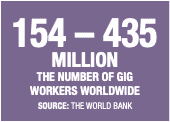
The World Bank estimates that there are between 154 million and 435 million gig workers worldwide, a workforce that is helping reshape the estimated $191 trillion cross-border payments market.
Financial institutions are looking to tap into the gig economy’s high-volume, low-value cross-border payments for freelancer payments, remittances, and small-business transactions. The market is projected to grow nearly threefold, from $674.1 billion to between $2.18 trillion and $2.52 trillion, over the next 8 to 9 years.
J.P. Morgan Payments recently expanded the cross-border payment capabilities of its Xpedite Remit offering by integrating Thunes’ Direct Global Network, enabling clients to make payments in more than 100 currencies via instant payment rails to accounts and, in some cases, to digital wallets.
“If you’re paying an individual in China, they probably want to receive it in their wallet rather than in their account,” Gayathri Vasudev, global head of high-value payments & FX at J.P. Morgan Payments, told Global Finance.
Cross-Border Payments Speed Up
Whether it’s Brazil’s PIX, India’s Unified Payment Interface, or the EU’s SEPA Instant Credit Transfer, the domestic instant payment rails have set a high bar for cross-border payment rails.
“Customers and businesses now expect domestic payments to be instant, transparent, and available 24/7,” said Albion Murati, a senior partner at McKinsey & Co., who moderated a panel on the topic at the recent Sibos conference in Miami. “Cross-border transfers, by contrast, do not always deliver the same experience.”
“In most jurisdictions now, the progress that retail and wholesale domestic payments have made in terms of having that great customer experience is there for all to see,” added panelist Simon Eacott, head of payments at NatWest. “And whilst cross-border, we have made a lot of progress over the years, it’s still lagging a little bit in many areas.”
However, the speed of cross-border transactions has improved dramatically, according to Swift performance data. For inward transactions, the average time for ANZ is about 90 seconds, said fellow panelist Lisa Vasic, managing director of transaction banking at ANZ.
Corporate treasuries could pay employee salaries in emerging markets, for example, $1,000 to $4,000, directly to an employee’s mobile money account or digital wallet, said Peter De Caluwe, co-founder and CEO of Thunes. “If it’s a corporate that is ordering 50 tons of chemicals for $2 million, it won’t be paid into a wallet. That is something that needs to be transacted with correspondent banks because there is trade financing involved.”
“Speed is not the issue that it once was,” said Vasic. “Similarly, on an outbound transaction in certain corridors, we are getting payments there in 40 seconds.”
Speed is important, but not as important as principle protection for low-value cross-border flows, added J.P. Morgan Payments’ Vasudev, who was also on the panel.
“It means no deductions,” she said. “What you send is what the beneficiary gets.”
For multinational employers, these advances should improve the cross-border contractor experience and reduce payment inquiries. Adoption, however, hinges on greater transparency and availability.
Rob Daly covers fintech and economics. Contact him at rdaly@gfmag.com.