




As their customer base grows fast, fintechs across the region are looking to become banks in the full regulatory and economic sense.
This article appears in the September 2026 issue of Global Finance Magazine.
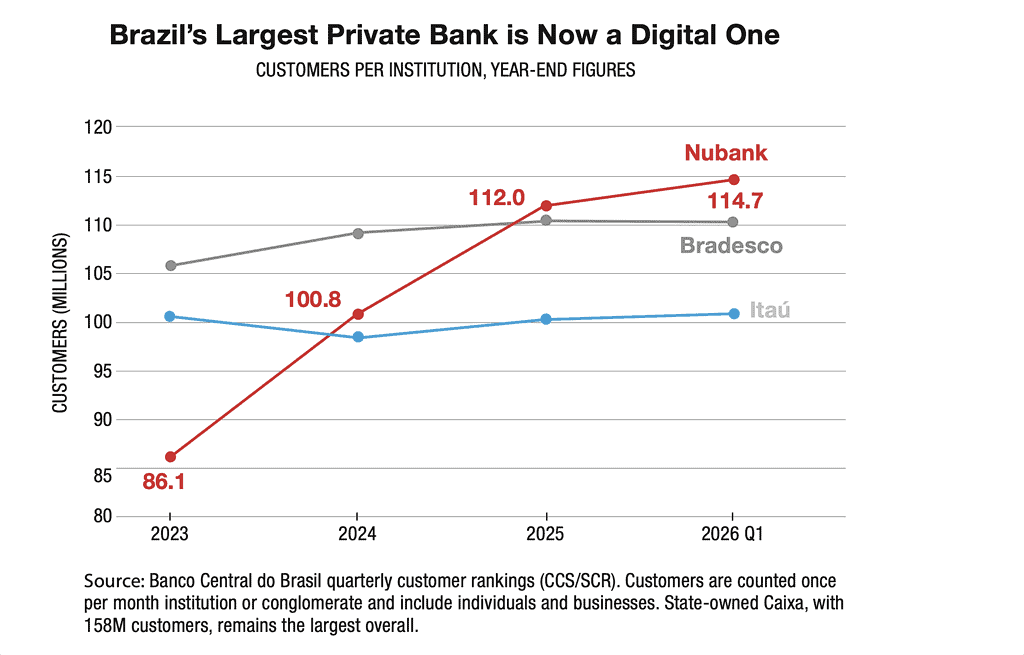
After nearly a decade of explosive growth, Brazil’s fintech industry has crossed a threshold that once looked unthinkable; a digital bank now counts more customers than any of the country’s storied private lenders.
According to recent data from the Central Bank of Brazil, nearly 60% of the nation’s adults now hold an account with Nubank, making it Brazil’s largest private financial institution by customer count, albeit still far from the largest by assets. Similarly, 55% of banked Brazilians primarily identify as customers of a digital bank or fintech, according to research organization Instituto Locomotiva.
“The fintech market has decidedly moved beyond access and into becoming the central piece of the Brazilian banking economy, also from the population’s perspective,” said Álvaro Machado Dias, associate director of Instituto Locomotiva.
The Brazilian experience reflects a broader shift across Latin America. Having secured a competitive customer base, the region’s fintechs are now seeking the licenses, deposits, and balance sheets that could allow them to become the banks they once set out to disrupt.
In Argentina, digital wallets have overtaken every other payment instrument, with 70% of consumers using them over the past six months compared with 52% for cash, according to Mastercard. Nu Mexico reaches roughly 15% of the adult population just seven years after entering the market, while Mercado Pago, the fintech arm of now-Montevideo-headquartered MercadoLibre Inc., now has 83 million monthly active users across eight countries, up 29% over the past year.
The shift is also changing how consumers transact. Sixty-one percent of Brazilian and 47% of Mexican consumers used a mobile device for their latest retail purchase, according to PYMNTS Intelligence’s Global Digital Shopping Index.
Having crossed that threshold with customers, the fintechs are now moving to the next stage: becoming banks in the full regulatory and economic sense. Nubank agreed in July to acquire Banco Porto Real de Investimentos S/A, enabling it to obtain a Brazilian banking license, while its Mexican unit began operating as a bank last month, becoming the first Mexican popular financial society (SOFIPO) authorized to convert.
Mercado Pago is close behind, with its own application reportedly first in line at Mexico’s banking regulator and an ambition to build the country’s largest digital bank. Mexican fintech Plata secured its license in February, while Argentina’s Ualá Bank SAU already holds a full banking license at home and in Mexico and a financing company license in Colombia.
Why A Banking License?
The economics of the transition are straightforward. As fintechs scale, the limitations of lighter regulatory charters become increasingly binding. Nu Mexico’s SOFIPO status, for example, allows deposit insurance of just 25,000 UDIs (Mexico’s inflation-indexed units of accounts) per client; a full banking license raises that ceiling sixteenfold. Banks can also compete for payroll accounts, held by only about a third of Mexican adults and concentrated largely among four incumbent institutions.
Most important, a banking license gives fintechs access to the deposits that provide the cheapest funding for a growing loan book.
Nu Mexico already holds $5.9 billion in deposits, which makes the ability to gather and deploy them at scale an increasingly important side of its business.
“Once a digital bank holds the same license, follows the same rules, and funds itself the same way, it stops being essentially different from a traditional bank,” said Reginaldo Nogueira, national director of Brazil’s Ibmec business and economics school. “The difference shifts to technology, efficiency, and customer experience.”
Accompanying that strategic shift is a much larger investment commitment. Founder David Vélez paired Nubank’s Mexican license with a projected $4.2 billion investment in the country through 2030.
The fintechs’ current profile marks a striking reversal from where the industry began. A decade ago, they were outsiders challenging Latin America’s established banks to control the region’s customers, branches and balance sheets. Today, they have crossed the most important threshold on the customer side. The next step is to acquire the regulatory privileges and funding advantages that underpin the banking business itself.
Thomas Monteiro is a contributing writer based in Spain.