


Continued conflicts prevent the central African nation from fully exploiting its natural riches.
The Democratic Republic of Congo (DRC) has been ravaged by what is aptly described as a “forgotten war” spanning more than three decades.
In June, US President Donald Trump decided it was time to silence the guns. The signing of a peace deal between the DRC and Rwanda at the White House in June was momentous.
To ensure the pact holds, the US sanctioned the armed groups and companies profiteering from the conflict through illicit mining and trafficking. The peace remains fragile. Government forces and the Rwanda-supported March 23 Movement (M23) still engage in atrocities. The UN estimates that over 1,000 civilians have been killed since the signing of the agreement.
“The Trump deal is an important step towards lasting peace, but there is a long way to go before the conflict is truly over,” says Christopher Vandome, a senior research fellow with the Chatham House Africa Program, adding that incentives to renege on the agreement remain high.
Fueling the DRC conflict are deeply entrenched ethnic tensions, weak governance, a history of external interference, and most fundamentally, the struggle for internal and external control of the country’s vast untapped mineral wealth, which the US International Trade Administration estimates is worth more than $24 trillion.
For the US, supported by Qatar and the African Union, durable peace and stability are critical for the DRC to benefit from its mineral resources, attract foreign direct investment (FDI), and turn a page toward economic transformation.
At present, China maintains a firm grip on the DRC’s minerals, including cobalt, a key ingredient in the rechargeable batteries that are critical for the green transition. More than 60% of production is tied to Chinese operators via long-term joint ventures, off-take agreements, and infrastructure-for-minerals deals.
“The rising interest presents DRC with a rare moment of geopolitical leverage,” observes Landry Djimpe, a managing partner at Paris-based Innogence Consulting. “If managed wisely, the country could witness a transformation.”
The Cost of Conflict
Decades of conflict have undoubtedly caused massive suffering in the DRC. The UN estimates that the conflict has killed over 6 million people. With millions more displaced and dependent on aid for survival, the country is one of the most unequal and vulnerable globally.
Despite that, the DRC is far from being considered a failed state. GDP expanded by 6.5% in 2024, driven by the extractive sector and recovery in the agricultural and services sectors. This year, the International Monetary Fund (IMF) projects a slower growth rate of 5.7%.
Inflation declined to 8.5% in June from 17.7% in 2024, and 23.8% in 2023, while foreign reserves have increased to $7.6 billion, supported by IMF disbursements under a program approved in January.
While the DRC is perceived as a volatile and risky market for investors, the UN Conference on Trade and Development’s World Investment Report 2025 notes that FDI inflows stood at $3.1 billion in 2024, up from $2.5 billion in 2023.
The surging demand for critical minerals used in electric vehicles and the transition to clean energy have made the mining sector a top attraction.
Last year, the country attracted $130.7 million in exploration investments alone, the highest in Africa, according to US Department of State data. The DRC produces more than 70% of the world’s cobalt and is its second largest copper producer. For columbite-tantalite (coltan) and diamonds, the country boasts 80% and 30% of global reserves, respectively. Other minerals the DRC holds include gold, silver, lithium, zinc, manganese, tin, uranium, and coal.
It is not surprising, therefore, that the DRC is fast becoming an epicenter of geostrategic competition for access, influence, and control. Currently, China boasts a commanding lead. The US and its companies, however, are determined to disrupt the status quo, particularly through the ambitious Lobito Corridor, which aims to link the DRC to Angola’s Atlantic coast.
In May, KoBold Metals agreed to acquire the Manono lithium deposit from Australian-based AVZ Minerals.
It is also committing to invest $1 billion to launch large-scale critical mineral exploration in the country.
Another US firm, America First Global, is part of a consortium that is eying the Rubaya coltan mine, which produces half of the DRC’s coltan—approximately 15% of the world’s reserves—according to ITA.
| VITAL STATISTICS |
|---|
| Location: Central Africa |
| Neighbors: Angola, Burundi, the Central African Republic, the Republic of the Congo, Rwanda, South Sudan, Tanzania, Uganda, and Zambia |
| Capital city: Kinshasa |
| Population (2025): 112.8 million |
| Official language: French |
| GDP per capita (2024): $686 |
| GDP growth rate (2024): 6.5% |
| Inflation (2024): 17.7% |
| Currency: Congolese franc |
| Credit rating: CCC+ (Fitch), B3 (Moody’s), B-/B (S&P Global) |
| Base interest rate: 17.5% |
| Investment promotion agency: National Agency for Investment Promotion (ANAPI) |
| Investment incentives: Exemptions from equipment and materials import duties, export duties and taxes; import VAT for new projects, corporate income tax, and property tax; streamlined business registration processes; special economic zones; bilateral investment treaties with numerous countries; party to dispute settlements organizations. |
| Corruption Perceptions Index rank (2024): 163 |
| Political risks: Endemic governance issues; government lacks full control of the country; judicial inefficiencies; pervasive corruption; human rights concerns; weak institutional capacity; no dedicated national ombudsman for investors |
| Security risks: M23 violence in eastern DRC; numerous armed groups; interference from outside forces; an under-skilled workforce; high youth unemployment; large and violent protests; high crime rate. |
| PROS |
|---|
| Abundant mineral resources |
| Major hydroelectric potential |
| Enormous agricultural potential |
| Large and rapidly growing population |
| CONS |
|---|
| Economy based mainly on mineral extraction |
| Dependence on commodity prices |
| Weak infrastructure |
| Propensity for epidemics (cholera and Ebola) |
| Widespread extreme poverty |
Sources: Trading Economics, IMF, FocusEconomics, World Bank, Macrotrends, Coface, Transparency International, PwC, ANAPI, US Department of State
Other powers, like the EU, India, Saudi Arabia, Russia, and the Persian Gulf states, are jockeying for position. In recent months, two United Arab Emirates giants, NG9 Holding and International Resources Holding, have secured major mining and renewable energy deals in the DRC.
“The scramble for minerals allows DRC to renegotiate contracts, push for local value addition, and assert greater control over pricing and benefits,” says Innogence’s Djimpe. But the high levels of interest come with potential risks, he adds, such as fragmented governance and opaque deals made for short-term geopolitical alignment.
In June, an audit by the country’s Court of Auditors unearthed significant discrepancies in revenues reported by mining companies, amounting to $16.8 billion. Notably, mining makes up for over 95% of export earnings, according to the US State Department.
“One way for the DRC to overcome the resource curse is better enforcement of tax payment: that is, making sure that companies are paying their dues,” says Chatham House’s Vandome.
Anglo-Swiss giant Glencore, China’s CMOC Group, and Canada’s Ivanhoe Mines are among the largest mining companies operating in the country. Luxembourg-based Eurasian Resources Group and Metorex, a subsidiary of the Chinese multinational Jinchuan Group, also have significant interests.
Beyond Mining
While mining remains central to the DRC’s economic renaissance, other sectors, such as energy, agriculture, transport, financial services, and mega infrastructure, are also attracting global attention.
In renewable energy, the country boasts 100,000 megawatts of hydroelectric potential, yet less than 3% is currently exploited. In agriculture, the DRC has over 80 million hectares of arable land and 4 million of irrigable land.
Yet, it has managed to utilize only 1% of them, according to the Food and Agriculture Organization of the UN.
For this reason, the country remains dependent on food imports, spending $3 billion annually.
Financial services, spanning banking, microfinance, insurance, and fintech, is another low-hanging fruit for investors. Although mobile penetration—currently at about 50%—is the lifeline for financial services access through mobile money, the DRC wrestles with low financial inclusion. The banking penetration rate is estimated at just 6% while the broader financial inclusion rate stands at below 40%, according to State Department data.
To close the gap, foreign banks from Kenya, Tanzania, Nigeria, and South Africa are making forays into the central African nation. Kenyan lenders KCB Bank and Equity Bank have become big players after entering the country through the acquisition of Banque Commerciale du Congo (BCDC) and Trust Merchant Bank, respectively. EquityBCDC, which has 2 million customers in the DRC, expects to grow to 30 million clients by 2030.
For the country’s people, socioeconomic transformation is intertwined with peace. Critics, including the Oakland Institute, argue that the US-brokered peace deal is a gimmick to open “a new era of exploitation.” But popular opinion holds that the deal offers the DRC its best chance at stability and prosperity.
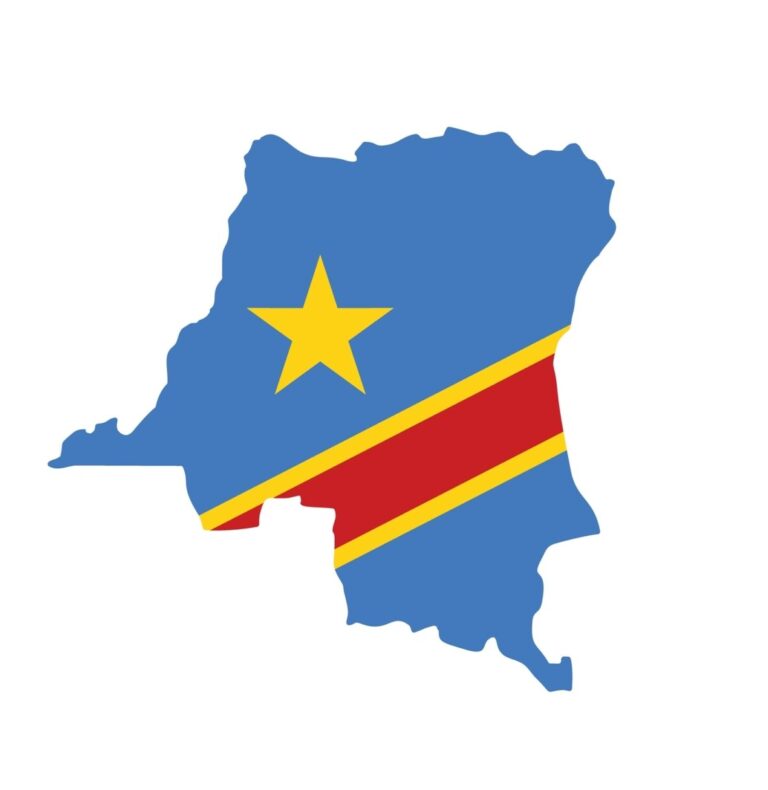
The Democratic Republic of Congo
For more information, read our Country Economic Data.