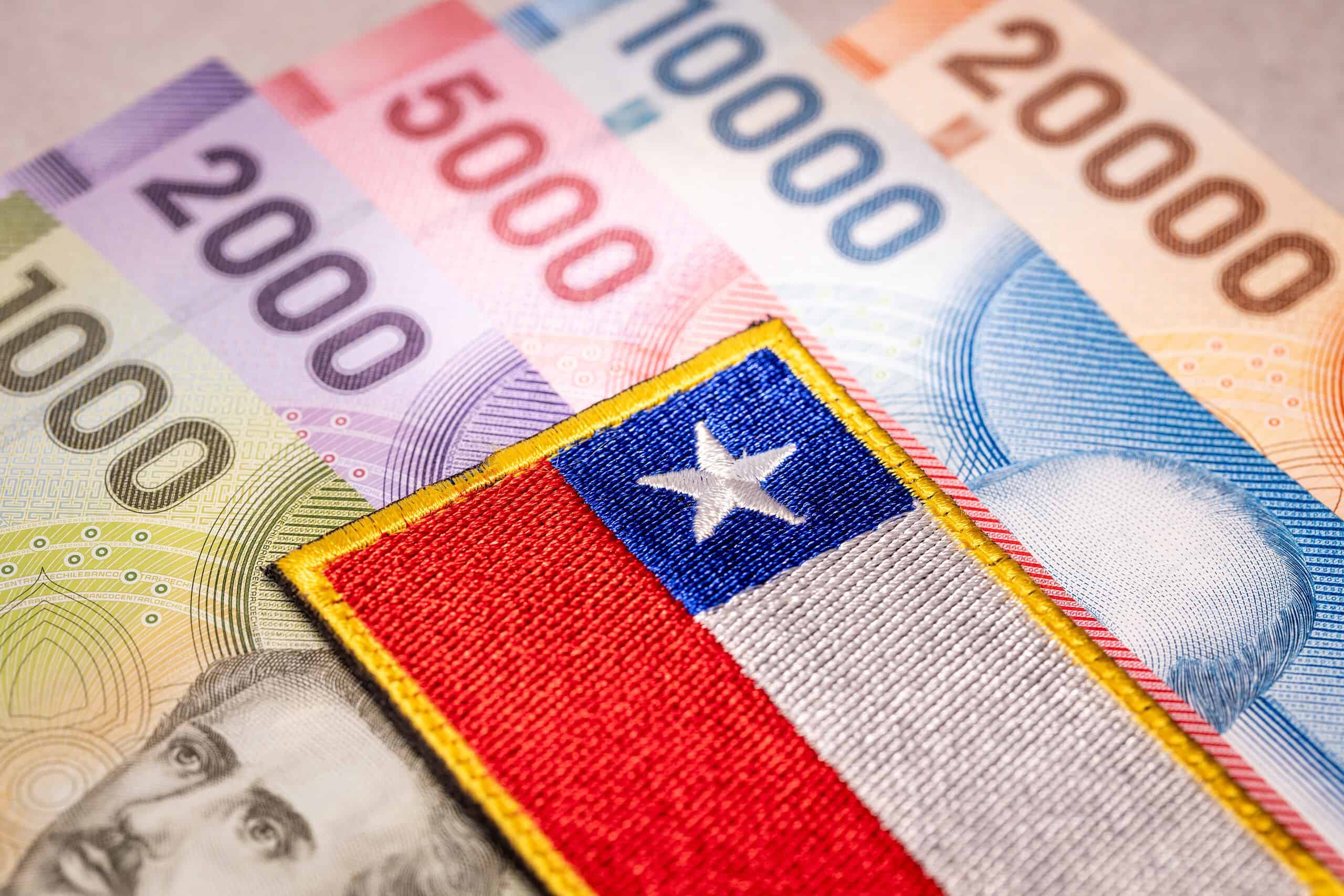


Facing economic headwinds, Chile's strong institutions and pro-investment reforms drive its rebound.
This article appears in the November issue of Global Finance Magazine.
In March, José Antonio Kast took the helm as Chile’s president, promising an “emergency government” to tackle rising unemployment, economic stagnation, and a rise in crime linked to organized groups and to migrants.
The initial economic prognosis is mixed.
GDP estimates have been regularly revised downward, with experts predicting 0-0.3% growth this year. However, the Andean nation’s mining and services sectors provide a foundation for diversification, especially into technology. The Kast government aims to unlock this potential by making Chile more business-friendly and attractive to investors.
“During the first quarter, [economic] activity was affected by transitory shocks in natural resource sectors, such as fishing, agriculture, and mining,” said Samuel Carrasco, chief economist for Chile at CredicorpCapital, “while in the second quarter, a decline in confidence—linked in part to rising oil prices—began to impact consumption and investment.”
In the short term, Chile faces multiple challenges. The El Niño weather phenomenon has brought above-average rainfall and disrupted production across various sectors. As in many other countries, fuel prices have risen sharply. In July, they increased by almost 30%, and another rise is expected. The government has revised the fiscal deficit upward from -1.8% of GDP to -2.4%. Unemployment, which had remained around 8% for three years, is now 9.6% for the June-August quarter, according to the Institute of National Statistics.
Yet Carrasco projects 3% growth in 2027. The medium-term outlook is brighter, with $24 billion in mining projects awaiting regulatory approval and new laws designed to attract foreign investment.
“The risk lies in the labor market slack that has accumulated, which may take longer to resolve,” said Andrés Pérez, chief economist for Latin America at Banco Itaú. “Ultimately, the primary driver of economic recovery in 2027 should be increased momentum in private investment.”
New Laws Aim to Attract Investment

Banco Itaú
Two pieces of legislation are key to Kast’s strategy for improving Chile’s image with international investors. The first is the National Reconstruction and Economic/Social Development Plan, which would reduce the corporate tax rate from 27% to 23%, add tax credits for remunerations, guarantee 25-year tax stability to incentivize investment, eliminate some capital gains taxes, and exempt those over age 65 from property tax. In particular, the bill aims to reactivate construction and dynamize the housing market. The bill is currently awaiting publication in the Official Gazette, after passing review by the Constitutional Court.
“The corporate tax cut, the tax stability regime, and the streamlining of environmental permits, among other measures, should boost long-term growth,” said Carrasco. “We estimate that, for the 2027-2028 period, these measures will contribute approximately 0.5 percentage points to annual GDP growth.”
The second bill is a capital markets reform measure that the Chilean Executive submitted to Congress in early September. It aims to boost market liquidity and facilitate investment in Chilean markets by modernizing the current tax regime; attracting investors to debt securities, listed equities, and investment funds; and promoting cross-border investment management activities.
The introduction of the two bills has helped increase business confidence over the past two months.
“The MK4 project[capital markets reform] aligns with a long-standing aspiration of the Chilean economy: to position the country as a regional financial hub,” said Pérez. “To that end, it proposes refining various measures intended to deepen capital market liquidity over time and, in turn, support the real estate sector.”
Foreign investment reached $10.1 billion as of July, boosted by administrative changes such as cutting waiting times for sector-specific permits and environmental licenses. Processing times have been cut by 30% to 70%, which has particularly helped mining, energy, and investment projects. Already, Law 21.770—the Framework Law on Sectoral Authorizations, or LMAS—passed in July 2025, has already improved legal certainty. It establishes common rules for all sectoral permits including standardized forms, mandatory admissibility tests, coordination of reports between institutions, and the use of the SUPER platform as a one-stop digital shop for permits. It also created a Sectoral Authorizations and Investment Office within the Economics Ministry.
LMAS is credited with spurring a record $16.46 billion in license approvals by the Chilean Environmental Assessment Service (SEA) in the second quarter of this year.
Quick Turnaround Possible
InvestChile, the public agency that promotes foreign investment in the country, reported that it helped facilitate $65.7 billion last year. Major brands that operate in Chile include Walmart Inc., Adidas AG, General Motors Co., and PepsiCo Inc. Meanwhile, Banco Santander S.A., Morningstar Inc., and Scotiabank offer financial services. Oracle Corp. is perhaps the best-known foreign technology company with a presence in the country, while InterSystems and EVYD Technology provide data management and AI solutions.
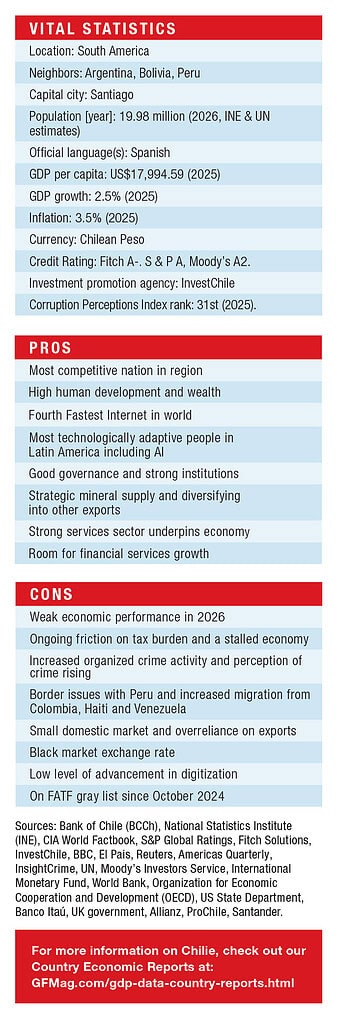
Chile’s reputation in the region for competitiveness, human development, wealth, and governance suggests the economy could turn around quickly. It has the fourth fastest internet in the world, according to a Latinometrics report. But for Chile to become a technology hub, energy and regulatory issues and human capital constraints need to be addressed, according to Carrasco.
“The country holds great potential for exporting financial services,” said Pérez. “Furthermore, its institutional stability fosters long-term investment in key sectors such as data, as evidenced by the anticipated investment in data centers within the country.”
Renewable energy, battery storage, tech, green hydrogen, and minerals other than copper add options for potential investors.
In the short term, however, Chile faces fiscal issues. Pension withdrawals during the Covid-19 pandemic caused savings to fall by about 20% of GDP. Meanwhile, the contributory pensions of almost 11 million workers still need to be restored. That said, “Chile remains one of the most institutionally robust and technologically advanced economies in Latin America,” said Carrasco. “It has built institutional, financial, and macroeconomic strengths that set it apart within the region and account for its leading position across various international indicators.
“However, this leadership is not without challenges. The country faces low trend growth, fiscal difficulties, structural labor market issues, low productivity, and a public perception that economic progress is not always sufficiently shared.”
Despite the opportunities, the speed of Chile’s rebound keeps close observers concerned.
“The region is poised to enter a favorable cycle,” said Pérez, “driven by several factors including favorable terms of trade, pro-growth agendas, and its geographic distance from major hotspots of geopolitical and military tension. In this context, Chile is particularly well-positioned. There is concern regarding the pace of recovery leading up to 2027. The turning point has clearly been delayed.”
Nic Wirtz is a contributing writer based in Nicaragua.